


 English
 русский
 Español
 عربى
عربى 简体中文
简体中文
Contact Us
All of your quotes will be answered within 2 hours by our professional sales support.
Industry News
 Home / News / Industry News / Comprehensive Guide To CNC Metalworking Lathes For Hobbyists And Small Shops
  2025.11.28
 Industry News
Contents
CNC metalworking lathes have become valuable tools in many small shops and hobby workspaces. Although manual and hybrid machines remain useful in certain situations, the growing accessibility of computer-controlled equipment allows users to achieve consistent, repeatable results with reduced setup effort.
A CNC metalworking lathe uses programmed commands to move the tool and workpiece. Manual lathes rely on operator control, while hybrid machines combine some automatic movement with manual adjustments.
| Machine Type | Advantages | Limitations |
| CNC lathe | High Repeatability; Automated Cycles; Consistent Surface Finishes; Ability To Run Complex Geometries; Integrates With Cad/Cam Workflow | Higher Initial Cost; Requires Programming Skills; Electrical/Maintenance Requirements; May Need More Floor Space |
| Manual Lathe | Direct Tactile Control; Low Entry Cost; Excellent For One-Off Simple Parts; Intuitive Operation | Limited Repeatability; Depends Heavily On Operator Skill; Time-Consuming For Complex Shapes; No Automated Toolpaths |
| Hybrid / Semi-Automatic Lathe | Faster Than Full Manual; Partial Automation For Feeds Or Threading; Good Bridge For Learners | Less Flexible Than CNC; Not Fully Automated; Still Requires Frequent Operator Intervention |
Overall, CNC lathes shine when tasks require precision over multiple runs, complex contours, or efficient production. Manual machines remain useful for quick shaping or when a project demands hands-on craftsmanship. Hybrid machines fit between the two, offering partial automation without full digital control.
CNC lathes typically use fixed tool holders mounted on a turret or tool post. These devices allow the machine to change tools automatically or semi-automatically during a cycle.
Types of tool-holding systems
Simple systems with one tool at a time; common on basic CNC conversions or compact machines.
A rotating drum or disk holding multiple tools. The control system rotates the turret to bring the required tool into position.
Allows rapid swapping of preset tool holders; often found on hybrid setups.
Optimizing tool layout
Group tools by operation order. Place roughing tools, finishing tools, drilling tools, and threading tools in the sequence used more frequently.
Minimize turret rotation. Reducing long indexing movements saves time, especially in small-run production.
Balance tool lengths. Keep tools of similar stick-out lengths close together to reduce vibration and allow consistent offsets.
Assign logical offset numbers. Clear labeling and digital offsets reduce errors during program editing.
Consider chip flow. Tools placed where chips can escape reduce heat buildup and improve surface finishes.
Effective tool layout planning can noticeably improve throughput, even on compact CNC machines used in hobby or small-scale environments.
Safety is a major advantage of modern CNC machines. Many models include full enclosures, interlocked doors, chip guards, and coolant shields, which limit direct exposure to rotating parts and hot chips.
Older manual or partially automated machines often have minimal guarding. Operators must remain close to the rotating workpiece, increasing the chance of accidental contact or exposure to flying debris.
While proper training remains essential for all machine types, CNC equipment generally allows safer operation through controlled movement and better containment.
Even a small lathe can create practical or decorative objects. With the addition of a drill press, more complex holes or cross-features become possible. Some popular project ideas include:
These projects do not require large production facilities; they are ideal for hobbyists who enjoy combining accuracy with creativity.
Selecting a machine for a small workshop requires considering space, cost, and intended use. Some helpful factors include:
Small CNC lathes vary widely in price. Consider not only the machine but also necessary accessories: Tooling, measuring instruments, and work-holding equipment.
Limited floor space may require a compact footprint. Ensure the machine fits through doorways and rests on a stable surface.
Some machines operate on standard household power; others require higher-voltage circuits.
Look for a controller capable of handling threading cycles, canned turning cycles, and basic G-code functions needed for your projects.
Choose a swing and distance between centers based on the largest parts you expect to make.
If you plan to work with harder metals, ensure the machine has sufficient rigidity.
Carefully balancing these considerations helps select a lathe that supports future growth without overwhelming a small workspace.
The typical CNC turning process involves several coordinated stages:
Design (cad)
Create a 2d profile or 3d model of the part. Keep dimensions clear and consider manufacturability—avoid extremely thin features and allow for safe tool access.
Programming (g-code / cam)
Setup on the lathe
Install the workpiece, set tool offsets, verify clearances, and check the spindle speed limits for the material.
Machining
Run the program one in rapid-speed reduction or “single-block” Mode. Confirm chip flow, coolant delivery, and tool stability.
Measuring and error control
After each critical cut, measure diameters and lengths. Adjust offsets or program values if necessary. Small corrections help maintain consistent tolerances.
CNC metalworking lathes offer an accessible pathway to precision turning for hobbyists and small shops.
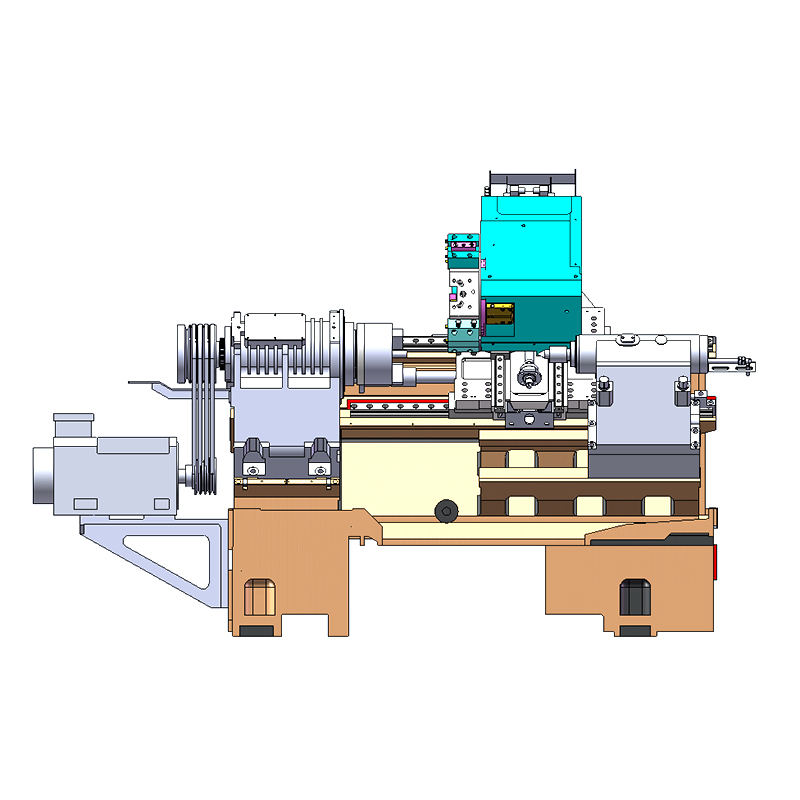
The C400K features a 45° slant bed and cast iron construction, providing high rigidity and vibration resistance—crucial for turning metal parts and ensuring stable operation over extended periods.
It is equipped with an 8–12-station servo-hydraulic turret, offering rapid tool changes and high positioning accuracy, suitable for machining complex parts requiring multiple tools and processes.
The spindle and slideway system are designed with thermal deformation and long-term accuracy stability in mind—extremely useful for applications demanding repeatability and part consistency.
The machine supports a fully enclosed enclosure, cooling system, and automatic lubrication system (optional), further enhancing its suitability for the safety and reliability requirements of modern workshops.
This type of lathe is commonly used for manufacturing shafts, discs, threaded parts, and parts with complex contours, and is also suitable for the small workshop/hobbyist needs and small-batch production requirements you mentioned earlier.
1. What is the main advantage of using a CNC metalworking lathe over a manual lathe?
A CNC lathe automates tool movement using programmed instructions, allowing for consistent accuracy, repeatable part quality, and efficient production of complex shapes. Manual lathes rely entirely on operator skill and are slower for repeated or intricate work.
2. What materials can be machined on a CNC metalworking lathe?
Most CNC lathes can handle a wide range of materials, including aluminum, brass, mild steel, stainless steel, and certain harder alloys. The exact capability depends on machine rigidity, spindle power, and tooling selection.
3. Do I need CAD or CAM software to operate a CNC lathe?
You can write G-code manually, but CAD/CAM software greatly simplifies creating accurate toolpaths, especially for complex features. CAM programs generate G-code automatically based on your 2D/3D design.
4. How do I maintain accuracy on a CNC metalworking lathe?
Regularly calibrate tool offsets, clean the machine, inspect the spindle and slideways, and manage heat buildup. Using stable fixtures, sharp tools, and proper cutting speeds also improves accuracy and surface finish.
5. Is a CNC metalworking lathe suitable for a small workshop or hobby space?
Yes. Many compact models are designed specifically for limited space. They offer reliable performance for small projects, custom parts, prototyping, and light-production tasks while fitting comfortably in smaller work areas.
RECOMMENDED PRODUCTS
All of your quotes will be answered within 2 hours by our professional sales support.
Use reliable parts and components to ensure product quality.
You can expect your order fulfilled within 60 days after placing the order.
All our products come with a one-year warranty.



sales@east-cnc.com

Shangma Industry Area, Shitang Town, Wenling City, Taizhou, Zhejiang, China.

Copyright © Taizhou Eastern CNC Technology Co., Ltd.

Machine Tool Manufacturer Privacy Policy