


 English
 русский
 Español
 عربى
عربى 简体中文
简体中文
Contact Us
All of your quotes will be answered within 2 hours by our professional sales support.
Industry News
 Home / News / Industry News / Exploring the Differences Between High-Precision CNC Lathes and Traditional Lathes
  2025.11.21
 Industry News
Contents
Precision CNC lathes and traditional lathes differ in several structural and functional aspects. A precision CNC lathe typically features a more rigid frame designed to maintain stability during automated cutting cycles, while a traditional lathe relies more on operator control and may use simpler structural reinforcements. In terms of accuracy, CNC systems use programmed tool paths and closed-loop feedback to maintain consistent dimensional results, whereas traditional lathes depend on manual operation, which introduces more variability.
The spindle systems also vary. Precision CNC lathes often use controlled spindle assemblies with balanced components to support steady rotation at a range of speeds. Traditional lathes generally use mechanical adjustments and simpler bearing arrangements. Guideway design presents another distinction: CNC lathes commonly employ linear or sliding guideways engineered for smooth, repeatable movement, while traditional lathes may use basic slide surfaces that require greater operator skill. Together, these differences shape how each machine meets different production needs.
The foundation of a high-precision lathe is its bed structure. Unlike conventional lathes, which often use V-shaped beds, modern T-series CNC lathes employ flat-bed designs made from high-rigidity cast iron or polymer concrete. This design offers good stability and vibration damping, which are crucial for maintaining machining accuracy over long cycles.
Key Advantages of Flat-Bed Structure:
|
Feature |
Traditional Lathe |
High-Precision CNC Lathe (T-Series) |
|
Bed Type |
V-shaped or slant bed |
Flat-bed, high-rigidity |
|
Material |
Cast iron |
Polymer concrete or high-strength cast iron |
|
Vibration Damping |
Moderate |
Excellent |
|
Thermal Stability |
Low |
High, with integrated temperature compensation |
|
Deformation Under Load |
Higher |
Minimal |
Flat-bed construction minimizes deflection and improves alignment between the spindle and guideways. The result is consistent accuracy even under heavy cutting loads or high-speed operations.
Designing a flat-bed CNC lathe with high rigidity is a key approach to improving machining stability and accuracy. A flat-bed structure distributes loads evenly along the longitudinal axis of the machine, helping the lathe maintain geometric consistency during cutting. When engineering a high-precision lathe, designers often begin by optimizing the bed’s cross-sectional stiffness. A wider, heavier, and symmetrically reinforced bed reduces bending deformation, especially when the machine handles variable cutting forces or long workpieces.
Another essential element is material selection. Using high-grade cast iron with controlled heat treatment allows the bed to absorb vibration and minimize residual stress. This contributes to consistent thermal behavior, which is important for precision turning. Finite-element analysis is frequently applied during development to evaluate the bed’s response to stress concentration, thermal gradients, and tool-point loading.
Attention must also be given to the connection interfaces. The alignment between the bed, saddle, and guideways directly influences straightness and repeatability. Precision scraping or grinding is used to ensure that mounting surfaces maintain uniform contact. When all these factors are integrated effectively, a flat-bed high-rigidity structure provides a stable foundation for a high-precision lathe, supporting repeatable cuts, smooth surface finishes, and reliable long-term accuracy.
Hydrostatic technology plays an important role in elevating the accuracy and stability of high-precision lathes. Hydrostatic guideways suspend the moving components on a thin film of pressurized oil, avoiding metal-to-metal contact. This eliminates stick-slip behavior and provides exceptionally smooth motion at both low and high feed rates. Because the oil film distributes load evenly, the guideways maintain stiffness under varying conditions, supporting micron-level positioning.
Similarly, hydrostatic spindles use an oil film to support the rotating shaft. This design minimizes friction, reduces temperature rise, and maintains consistent rotational accuracy even during extended duty cycles. The absence of mechanical wear also contributes to long service life and stable performance. In precision turning applications, hydrostatic spindles help achieve fine surface finishes and reliable roundness, especially when cutting materials that require low vibration and constant feed.
Another advantage is the damping capability inherent in hydrostatic systems. The oil film absorbs high-frequency vibrations generated during cutting, improving tool life and dimensional control. Although hydrostatic components require specialized pumps and fluid management, the resulting benefits—smooth motion, thermal stability, and reduced mechanical wear—make them well suited for high-precision lathes used in advanced manufacturing environments.
Precision in CNC turning is measured by spindle runout, repeatability, and positioning accuracy. High-precision lathes outperform traditional lathes by an order of magnitude in these parameters:
|
Parameter |
Traditional Lathe |
High-Precision CNC Lathe |
|
Spindle Runout |
5–10 µm |
0.5–1 µm |
|
Repeatability |
±5 µm |
±5 µm |
|
Positioning Accuracy |
±10 µm |
±1 µm |
The spindle is the heart of a lathe, directly affecting the surface finish and dimensional accuracy of the workpiece. High-precision lathes often use hydrostatic or static-pressure spindles, unlike the ball-bearing spindles commonly found in conventional machines.
Benefits of Hydrostatic Spindles:
Temperature-induced expansion is a major factor in spindle deviation. T-series high-precision lathes incorporate thermal compensation software, which dynamically adjusts tool paths and spindle speed to maintain tolerances.
Guideways determine the smoothness and rigidity of linear motion. While traditional lathes rely on box-way or V-way sliding guideways, high-precision machines adopt hydrostatic or linear roller guideways, ensuring minimal friction and backlash.
Comparison Table:
|
Guideway Type |
Friction |
Backlash |
Thermal Drift |
Load Capacity |
|
Box Way (Traditional) |
Moderate |
Moderate |
High |
Moderate |
|
Hydrostatic Guideway (High-Precision) |
Very Low |
Near Zero |
Low |
High |
Hydrostatic guideways use a thin layer of pressurized oil to support the moving carriage. This eliminates metal-to-metal contact, reducing wear and improving repeatability over long production runs.
High-precision CNC turning is not only about hardware. Software control plays a critical role in achieving the desired tolerances. T-series CNC lathes use advanced path planning algorithms*and feed speed interpolation, which optimize cutting conditions for complex profiles.
Key Features:
Impact on Accuracy:
Proper path planning reduces dynamic errors and ensures surface finishes with roughness values as low as Ra 0.2 µm.
Temperature variations during long production runs can cause spindle expansion and positional drift. High-precision lathes integrate thermal sensors*and compensation algorithms that adjust tool paths in real time.
Typical Performance Metrics for T-Series Lathes:
|
Metric |
Specification |
|
Spindle Runout |
≤ 0.5 µm |
|
Repeatability |
±0.5 µm |
|
Thermal Drift Compensation |
±1 µm over 8 hours |
This level of control ensures the machine can produce high-volume, high-precision components without manual intervention.
For industries requiring large batches of precise components, automation and workflow optimization are essential. T-series CNC lathes support:
Workflow Example:
This integrated approach minimizes human error and ensures consistent quality across thousands of parts.
While high-precision lathes offer good accuracy, they also present challenges:
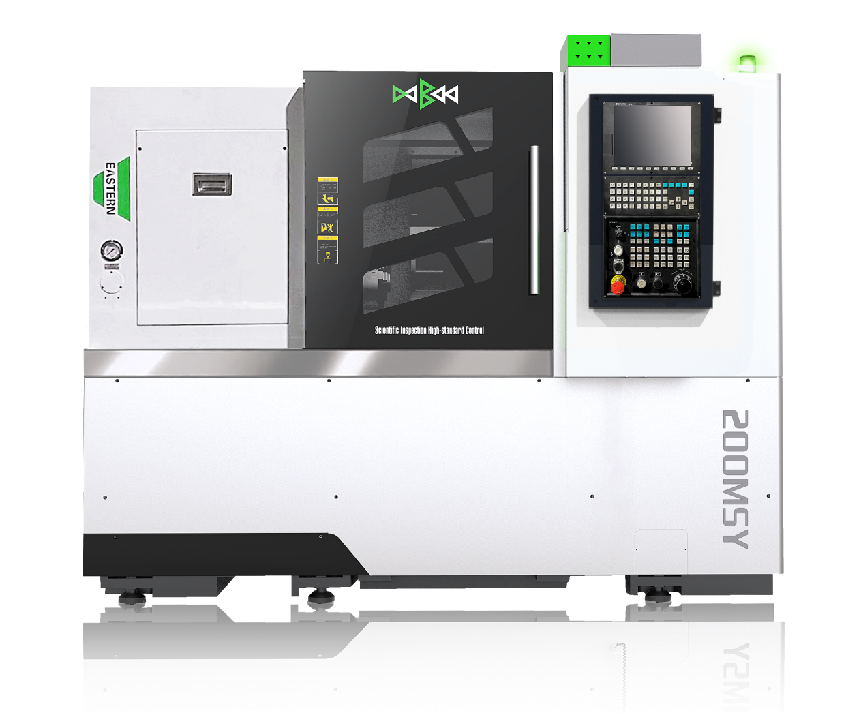
If you want a high-precision lathe, it's wise to focus on machines that offer tight tolerances and consistent performance under various workloads. We highly recommend the Dongbu CNC C400K CNC slant bed lathe, which perfectly balances precision, rigidity, and practicality, making it ideal for start-up machining workshops.
It features a 45° integrated slant bed design with a bed made of resin sand cast iron, enhancing structural stability and impact resistance.
Its spindle uses double-row cylindrical roller bearings and angular contact thrust bearings, helping to maintain consistent accuracy over long periods of operation.
This machine tool is equipped with a hydraulic servo turret (8-station or 12-station) for efficient tool changes and high repeatability.
The X/Z axes are driven by ball screws with fixed screw ends, minimizing screw deformation and ensuring precise movement.
It supports multiple configurations: a big turning diameter of 320 mm, a big machining length of 450 mm, and can be equipped with servo spindles, hydraulic through chucks, or programmable tailstocks.
This lathe combines high precision with flexibility, suitable for a variety of tasks from prototyping to long-term production. For first-time users, it offers a balanced approach, allowing you to easily get started with high-precision CNC turning without facing overly complex operations.
1. What features help a lathe maintain stable and accurate machining?
A high-precision lathe often uses a rigid machine structure, controlled spindle system, and well-designed guideways. These elements help reduce deformation and support repeatable tool movement.
2. How does a high-precision lathe differ from a standard CNC lathe?
Compared with general CNC models, precision lathes focus more on structural stiffness, thermal control, and improved motion accuracy. They are designed for tighter dimensional consistency.
3. Why is spindle quality important?
The spindle influences rotational accuracy, heat generation, and vibration. A well-balanced spindle with suitable bearings helps ensure smooth rotation and stable cutting conditions.
4. How do guideways affect repeatability?
Guideways control how the saddle and turret move. Linear or enhanced sliding guideways provide smoother travel, supporting reliable positioning in fine-tolerance work.
5. How does thermal stability impact accuracy?
Temperature changes can cause material expansion. A precision lathe manages heat distribution to keep its geometry consistent during longer machining cycles.
6. What type of workholding is suitable for precision turning?
Workholding should provide firm, balanced clamping without deforming the part. Options such as soft jaws, collets, or tailored fixtures help maintain alignment.
7. What maintenance helps preserve accuracy?
Regular cleaning, lubrication, alignment checks, and inspection of spindle and guideways help the machine maintain stable performance.
8. What environment supports high-accuracy machining?
A workshop with controlled temperature, reduced vibration sources, and clean conditions supports more consistent results.
RECOMMENDED PRODUCTS
All of your quotes will be answered within 2 hours by our professional sales support.
Use reliable parts and components to ensure product quality.
You can expect your order fulfilled within 60 days after placing the order.
All our products come with a one-year warranty.



sales@east-cnc.com

Shangma Industry Area, Shitang Town, Wenling City, Taizhou, Zhejiang, China.

Copyright © Taizhou Eastern CNC Technology Co., Ltd.

Machine Tool Manufacturer Privacy Policy