


 English
 русский
 Español
 عربى
عربى 简体中文
简体中文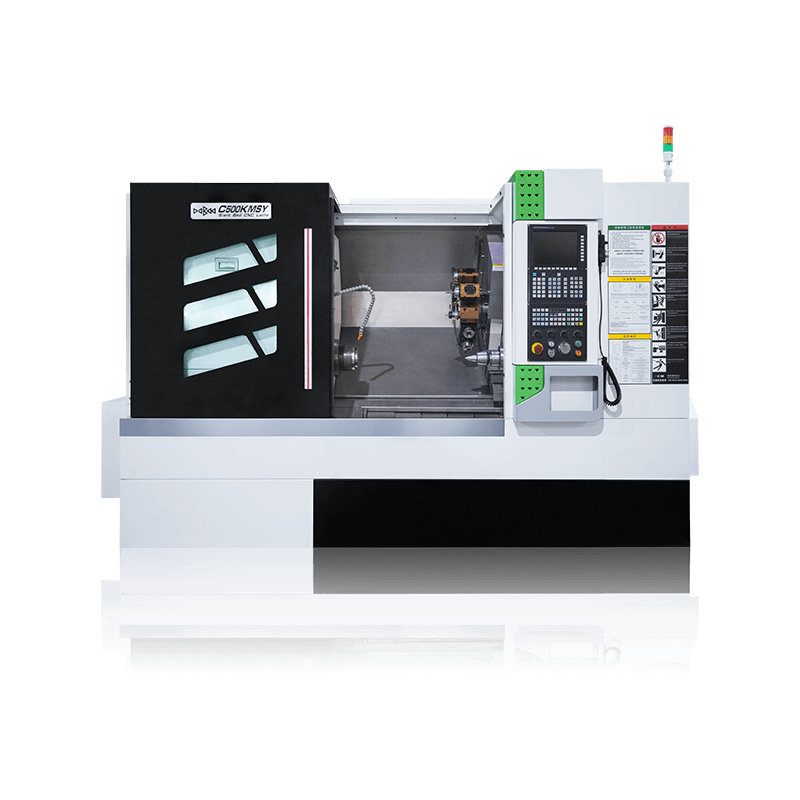
Contact Us
All of your quotes will be answered within 2 hours by our professional sales support.
Industry News
 Home / News / Industry News / Can a dual-spindle lathe with a Y-axis replace a lathe and a milling machine?
  2026.07.10
 Industry News
Contents
In the past two years, many small and medium-sized machine shops have faced a common set of challenges: difficulty in recruiting skilled labor, shrinking batch sizes, and increasingly complex part geometries. Previously, a part might be turned on a conventional lathe and then moved to a milling machine for drilling or keyway milling; however, this "two-setup, two-machine, two-operator" workflow is becoming increasingly difficult to sustain under the pressure of tight delivery deadlines. Every time a workpiece is transferred from the lathe to the milling machine, it requires re-alignment and re-tool setting—processes that can subtly amplify errors and reduce overall efficiency.
It is against this backdrop that Y-axis dual-spindle lathes have increasingly captured the attention of purchasers and process engineers. By integrating both turning and milling operations into a single machine, they aim to fundamentally eliminate the issues associated with transferring parts between machines. This article seeks to answer a key question: Can a Y-axis dual-spindle lathe truly replace the traditional combination of a lathe and a milling machine?
For a long time, there was a clear division of labor between lathes and milling machines: lathes handled "turning" tasks—such as external profiles, internal bores, and threading—while milling machines handled "non-rotational" features like flat surfaces, keyways, and side holes. Consequently, any part requiring both turning and milling operations necessitated a secondary setup. While there is nothing inherently wrong with this process, it reveals several distinct shortcomings when viewed against the backdrop of today's production pace:
Against this backdrop, many factories are considering using a single machine to perform multiple operations, primarily for the following reasons:
Each approach has its own logic regarding suitability; comparing them side-by-side offers a clearer perspective.
| Comparison Dimension | Traditional Lathe + Milling Machine Combo | Y-Axis Dual-Spindle Lathe |
| Clamping Operations | Usually requires 2 or more setups | Most parts can be completed in a single setup |
| Number of Machines | At least 2 machines | 1 machine |
| Operators | Usually requires 1–2 people working in coordination | Can be operated by a single person |
| Concentricity Control | Relies on re-alignment; risk of cumulative error | Fewer setups; cumulative error is relatively controllable |
| Lateral Milling/Drilling/Keyways | Performed separately by a milling machine | Performed via Y-axis interpolation and a live-tool turret |
| Suitable Batch Sizes | High-volume, simple-process parts | Small-to-medium batches, complex-structure parts |
| Initial Investment | Lower cost per machine, but requires a second machine | Higher cost per machine, but reduces subsequent labor and floor space costs |
| Unattended Operation | Requires coordination between two machines; scheduling is complex | Processes concentrated on one machine; scheduling is simple |
It should be noted that this comparison is based on general machining logic; specific results for a given machine or part will vary depending on tooling configuration, programming proficiency, and operator skill.
Returning to the core question of this article: the answer is not a simple "yes" or "no." More accurately, in specific scenarios, a Y-axis dual-spindle lathe can partially replace the traditional lathe-and-milling-machine setup; however, whether it can *fully* replace it depends on the part's geometry, machining requirements, and production model.
For instance, if a part is primarily a rotational body requiring only a few lateral holes, keyways, or face-milling operations, a Y-axis dual-spindle lathe can generally complete the job in a single setup, offering a clear advantage. However, if milling operations constitute a large portion of the process—or involve machining large flat surfaces or complex cavities—relying solely on a lathe's live-tool turret and Y-axis capabilities is often less efficient than using a dedicated milling machine or machining center.
Therefore, a more practical perspective is this: the Y-axis dual-spindle lathe addresses efficiency issues for parts requiring "combined turning and milling where turning dominates," rather than aiming to replace the entire category of milling machines in every scenario.
Practical experience shows that Y-axis dual-spindle lathes yield particularly significant benefits for the following types of parts:
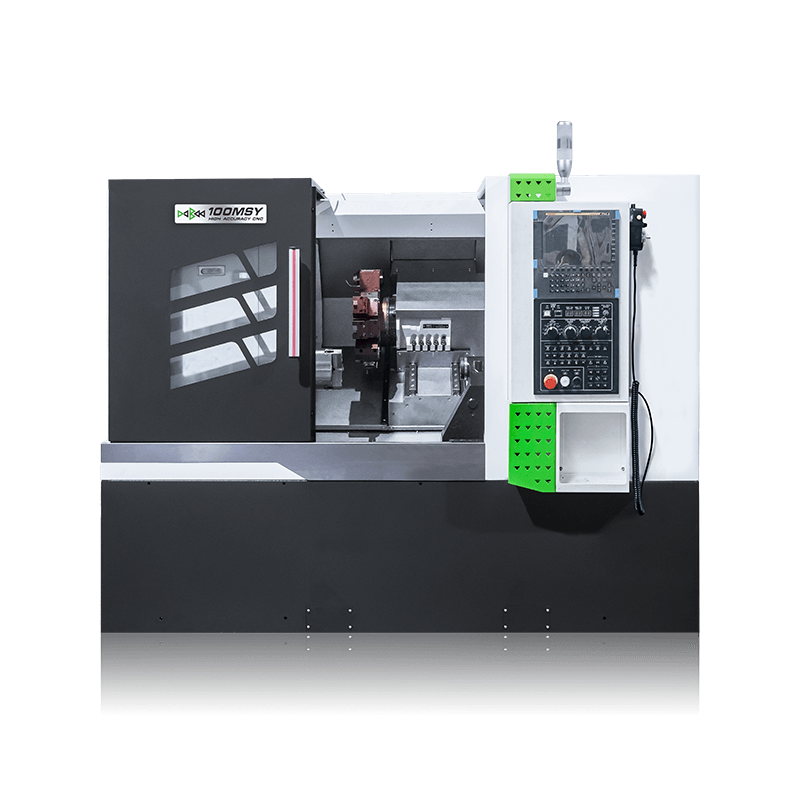
Take the Eastern CNC 100MSY slant-bed dual-spindle lathe (configured with a Y-axis and sub-spindle) as an example. This high-performance machine is ideally suited for precision connectors featuring side holes, eccentric features, and complex end-face structures. It features a 30° slant bed, a highly rigid simulated Y-axis structure, a 12-station live-tool turret (BMT45), and integrated main and sub-spindles (with a main spindle speed of 5,000 rpm), enabling multi-axis coordinated operations including turning, milling, drilling, tapping, and eccentric machining.
In practical applications, parts that previously required separate turning and milling operations—along with multiple setups—can now be fully machined in a single setup. This significantly reduces workpiece handling, re-clamping, and positioning errors, thereby enhancing dimensional consistency and production efficiency. The sub-spindle synchronous transfer capability allows for simultaneous machining of both ends of the part, further shortening cycle times. This model is particularly well-suited for the medium-batch production of small-to-medium diameter fittings, valve bodies, connectors, medical devices, and precision automotive components; it combines high precision with great flexibility while significantly reducing the need for manual intervention and minimizing the machine's footprint.
A Y-axis, dual-spindle lathe is a strong candidate if the following conditions apply:
Conversely, the traditional combination may still be more practical in the following scenarios:
A: There is some overlap, but they are not identical. A Y-axis, dual-spindle lathe emphasizes the division of labor between two spindles and Y-axis lateral milling capabilities. A turn-mill center typically offers a wider range of functions and a greater number of simultaneously controlled axes, depending on the specific machine configuration.
A: No. Parts requiring extensive milling or featuring highly complex geometries may be more efficiently produced using dedicated milling machines or machining centers; Y-axis dual-spindle lathes are better suited for parts where turning is the primary operation, supplemented by a limited number of milling features.
A: Generally, there is an adjustment period for programming and operation—particularly regarding synchronized dual-spindle machining and Y-axis interpolation—as the operational logic differs from that of single-spindle lathes.
A: If the orders involve a wide variety of parts and frequent changeovers, the time savings gained from reducing the number of machine setups are often significant; however, cost-effectiveness should be evaluated based on specific part geometries and existing production capacity.
RECOMMENDED PRODUCTS
All of your quotes will be answered within 2 hours by our professional sales support.
Use reliable parts and components to ensure product quality.
You can expect your order fulfilled within 60 days after placing the order.
All our products come with a one-year warranty.



sales@east-cnc.com

Shangma Industry Area, Shitang Town, Wenling City, Taizhou, Zhejiang, China.

Copyright © Taizhou Eastern CNC Technology Co., Ltd.

Machine Tool Manufacturer Privacy Policy