


 English
 русский
 Español
 عربى
عربى 简体中文
简体中文
Contact Us
All of your quotes will be answered within 2 hours by our professional sales support.
Industry News
 Home / News / Industry News / CNC Vertical Turret Lathes: A Comprehensive Analysis of Principles, Selection, and Applications
  2026.03.13
 Industry News
Contents
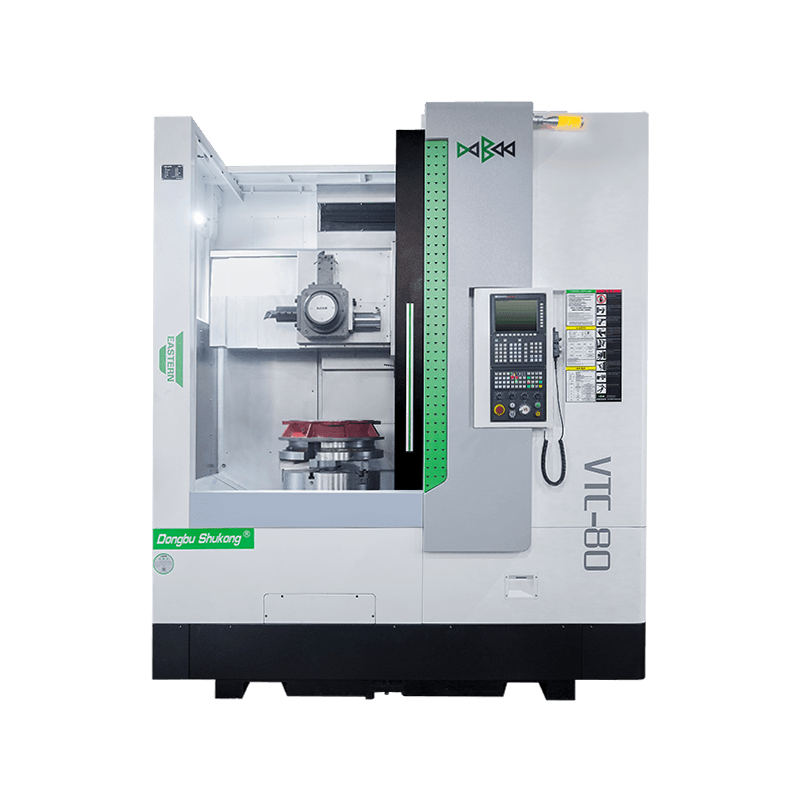
A CNC Vertical Turret Lathe (VTL) is a computer numerical control (CNC) turning machine characterized by a vertically oriented spindle, wherein the workpiece rotates horizontally atop a worktable. Unlike horizontal lathes, the VTL positions the workpiece "flat" on a rotating table, allowing the tool holder to approach from above or the side to execute a variety of machining operations—including turning, boring, grooving, and milling.
Its core structure comprises several key components: the rotating worktable (which supports and drives the workpiece's rotation), the column (which supports the crossbeam and tool holder), the turret tool holder (capable of mounting multiple tools for automatic tool changing), and the CNC control system (which governs the coordinated movement of various axes and cutting parameters). During machining, the workpiece executes the primary rotational motion while the cutting tool feeds along vertical or horizontal axes, thereby achieving precise dimensional control.
This vertical configuration offers significant physical advantages: the direction of gravity aligns with the spindle axis, meaning the workpiece's weight is borne directly by the worktable rather than being suspended from the end of the spindle. This inherent structural stability makes the machine ideally suited for processing large-diameter, heavy-mass workpieces.
In the realm of heavy-duty machining, the size and weight of the workpiece often serve as the primary constraints when selecting a machine tool. Consider a wheel hub or flange—exceeding one meter in diameter and weighing several tons—if placed on a horizontal lathe for machining, not only would clamping prove difficult, but the spindle bearings would also be subjected to immense cantilever bending moments, severely compromising both machining accuracy and the service life of the equipment.
The CNC Vertical Turret Lathe fundamentally resolves this issue. With the workpiece positioned horizontally on the rotating worktable, the clamping process is akin to simply "placing" the part on the ground, eliminating the need for complex support fixtures. Furthermore, the workpiece benefits from a low center of gravity and good rotational stability; even geometrically irregular castings can be quickly centered through simple adjustments of the clamping jaws.
Additionally, the vertical structure facilitates the natural, gravity-assisted drainage of cutting fluids and chips. These materials do not tend to accumulate within the machining zone, a feature that not only protects the cutting tools but also mitigates the risk of thermal deformation. For large workpieces requiring prolonged rough machining, this characteristic is crucial for maintaining machining precision.
Precisely for this reason, the heavy-duty component machining sectors—including energy equipment, rail transit, mining machinery, and shipbuilding—rely almost exclusively on CNC Vertical Turret Lathes.
The application scope of CNC Vertical Turret Lathes focuses primarily on rotational parts such as discs, rings, and hubs. Specifically, this includes:
CNC Vertical Turret Lathes are categorized into single-column and double-column (also known as "gantry-type") configurations based on the number of supporting columns. The differences between these two types directly determine the machine's applicable specifications and its big performance capabilities.
The structure of a single-column vertical lathe is relatively simple: the crossbeam is cantilevered from—or supported at one end by—a single column, while the tool post traverses laterally along the crossbeam. The advantage of this structural design lies in its small footprint, low manufacturing cost, and spacious operating area, making it suitable for machining medium-sized parts with diameters ranging from 800 mm to 2000 mm. However, due to its cantilever-beam structure, the free end of the beam is prone to slight deflection under heavy cutting loads, which can have a certain impact on machining precision.
In contrast, the crossbeam of a double-column vertical lathe is supported at both ends by two upright columns, forming a closed-frame structure that significantly enhances rigidity. This configuration effectively resists deformation caused by cutting forces, making it ideal for machining ultra-large parts with diameters exceeding 2000 mm and weights exceeding 10 tons. Furthermore, the double-column structure allows for the simultaneous mounting of two tool posts on the crossbeam, enabling synchronized machining from both the left and right sides and thereby significantly boosting machining efficiency.
Selection Recommendations: For workpieces with diameters under 2 meters and relatively small production batches, the single-column configuration offers a good cost-performance ratio. However, if the application involves machining ultra-large workpieces, or if there are stringent requirements regarding precision and efficiency, priority should be given to double-column equipment. Additionally, a comprehensive assessment of infrastructure conditions—such as workshop ceiling height and pit depth—should be conducted during the selection process.
In the machining of large parts, the primary objective during the roughing stage is to remove a substantial amount of excess material as rapidly as possible; spindle power is the critical parameter that determines the efficiency of this rough machining process.
Spindle power directly dictates a machine tool's capacity for continuous cutting under conditions involving large depths of cut and high feed rates. Machine tools with insufficient power are prone to "stalling" (or "bogging down") when performing heavy-material-removal cuts—a phenomenon characterized by a sudden drop in spindle speed, or even the triggering of an overload protection shutdown. This not only results in inefficient operation but also imposes additional wear and tear on the spindle drive system.
Consider, for example, the machining of a cast iron gear blank with a diameter of 1.5 meters. If the machine is equipped with a 30 kW spindle, the cutting depth is typically limited to within 8 mm. Conversely, a machine equipped with a spindle of 55 kW or higher can easily achieve a single-pass cutting depth of 15 mm or more, thereby reducing the rough machining time per workpiece by over 40%.
Furthermore, the combination of a high-power spindle and a high-rigidity machine bed structure allows for the maintenance of aggressive cutting parameters while preserving cutting stability. This prevents tool chatter, extends tool life, and ultimately results in lower overall machining costs. Therefore, when procuring a CNC vertical turret lathe, one should not select a low-power configuration solely for the sake of cost savings. Instead, the spindle power should be appropriately matched to the workpiece material, typical machining allowance, and production cycle time requirements to ensure the equipment can perform at its full potential during the rough machining phase.
An innovative structural design—the Inverted Spindle Vertical Turret Lathe (Inverted Spindle VTL)—is rapidly gaining popularity in the field of automated machining. As the name suggests, the spindle on this type of machine tool faces downward; the workpiece is gripped from above by the chuck, and throughout the entire machining process, the workpiece remains suspended from the inverted spindle while undergoing rotational cutting.
This design offers revolutionary advantages in terms of automation:
Currently, this machine configuration is widely deployed in mass production environments for small to medium-sized disc-shaped parts—such as automotive components, bearing rings, and hydraulic elements. It stands as a pivotal piece of equipment in driving the transformation of machining workshops toward intelligent manufacturing.
By virtue of their unique vertical layout, CNC vertical turret lathes occupy an indispensable position in the machining of large and heavy workpieces. From the structural choice between single-column and double-column configurations, to the profound impact of spindle power on rough machining efficiency, and finally to the automation breakthroughs enabled by inverted spindles—every design detail embodies a deep responsiveness to actual production requirements. Understanding these underlying principles and distinctions is a crucial prerequisite for process engineers to make sound equipment selections and fully unlock the potential of their machinery.
In the realm of machining large, heavy-duty components, selecting a CNC vertical turret lathe with reliable performance and an optimized configuration often directly determines the upper limits of production efficiency and machining quality. Eastern CNC has dedicated years to deep specialization within the field of CNC machine tools, offering a comprehensive series of vertical turret lathes encompassing various configurations—including single-column, double-column, and inverted-spindle models. Whether addressing the medium-batch machining of disc-shaped parts—such as flanges, gear blanks, and hubs—or meeting the heavy-duty roughing requirements for massive castings and forgings, there is a specific model available to suit every need. Their products have undergone systematic optimization regarding spindle power configuration, machine bed rigidity, and CNC system integration, thereby effectively meeting the dual demands of high-efficiency rough machining and high-precision finish machining. If you are planning a workshop equipment upgrade, evaluating options for a new production line, or wish to learn more about the technical specifications and application scenarios for various vertical turret lathe models, we invite you to visit east-cnc.com for detailed product information, or to contact our technical team directly for tailored process consultations and customized solutions.
RECOMMENDED PRODUCTS
All of your quotes will be answered within 2 hours by our professional sales support.
Use reliable parts and components to ensure product quality.
You can expect your order fulfilled within 60 days after placing the order.
All our products come with a one-year warranty.



sales@east-cnc.com

Shangma Industry Area, Shitang Town, Wenling City, Taizhou, Zhejiang, China.

Copyright © Taizhou Eastern CNC Technology Co., Ltd.

Machine Tool Manufacturer Privacy Policy