The Advantages of the Y-Axis in CNC Lathes: Why Is It Becoming Increasingly Important?
In the field of precision parts manufacturing, machining complex geometries has long been a core challenge for traditional lathes. As industries such as medical devices and automotive manufacturing continue to raise their standards for part precision and complexity, Y-axis live tooling lathes are gradually becoming standard equipment for high-end manufacturing enterprises.
Traditional CNC lathes possess only two dimensions of linear motion—the X-axis (radial) and the Z-axis (axial); even when combined with C-axis rotation, they can only execute basic milling and drilling operations. When a part requires machining features such as keyways, angled holes, eccentric elements, or complex contours at positions off the rotational center, relying solely on the X/Z/C axis combination makes true off-center machining impossible.
The introduction of the Y-axis fundamentally alters this situation. The Y-axis provides the cutting tool with a third dimension of linear motion—specifically, lateral movement perpendicular to the spindle centerline. This enables the lathe to complete complex feature machining—tasks that would otherwise require transferring the workpiece to a separate machining center—all within a single clamping setup. This enhancement in capability is directly reflected in the following key metrics:
- Reduced number of clamping setups, lower cumulative error
- Reduction in handling and repositioning time by approximately 60%
- Positioning accuracy reaching the ±0.005mm level
- Overall machining efficiency increased by 3 to 5 times
The core value of the Y-axis lies not merely in the addition of "one extra axis," but in its ability to truly integrate the capabilities of a lathe with those of a machining center, thereby realizing a manufacturing paradigm of "multiple processes completed in a single clamping setup." This is the fundamental reason behind its rapidly growing market penetration worldwide.
What Is a Y-Axis Live Tooling Lathe? How Does It Work?
A Y-axis live tooling lathe—also referred to in English as a "Y-axis turning center"—is a type of multi-tasking CNC lathe that integrates Y-axis linear motion functionality. The tools mounted on its turret are capable of not only moving along the X and Z axes but also executing precise displacements along the Y-axis direction, thereby enabling off-center milling, drilling, and complex contour machining.
The core operating principle consists of four steps:
- Step 1: Spindle Clamping and C-axis Positioning The workpiece is clamped by the spindle chuck; the C-axis precisely rotates the spindle to a specified angular position and locks it in place, providing a reference angle datum for subsequent Y-axis machining operations.
- Step 2: Y-axis Offset Movement The tool turret moves along the Y-axis direction to a target offset distance, displacing the tool's centerline relative to the workpiece's axis of rotation, thereby achieving true eccentric machining positioning.
- Step 3: Live Tooling Milling/Drilling A servo motor built into the tool turret drives the live tool to rotate at high speed (typically 500–6000 rpm); combined with simultaneous 3-axis (X/Y/Z) motion control, this enables operations such as milling, tapping, and drilling eccentric holes.
- Step 4: Continuous Execution of Compound Operations The CNC system automatically switches between operations—such as turning, milling, and drilling—according to the programmed sequence. This process requires no manual intervention and is completed entirely within a single workpiece setup (clamping).
Compared to live-tooling turrets equipped solely with a C-axis, the addition of a Y-axis ensures that the actual tool offset distance no longer relies on a "virtual Y-axis" (i.e., an approximation simulated via X-axis and C-axis simultaneous motion). Instead, geometric accuracy is guaranteed through actual physical movement along the Y-axis—a critical factor for machining high-precision eccentric features.
Advantages of Y-axis Live Tooling Lathes in Complex Part Machining
- True Y-axis Offset Machining for Enhanced Reliability: Eliminating the need for approximations based on X-axis and C-axis simultaneous motion, the machine achieves the required offset position directly through linear movement along the Y-axis. This results in higher machining precision and more intuitive programming, making it particularly well-suited for parts with strict tolerance requirements.
- Process Consolidation to Eliminate Clamping Errors: Multiple operations—such as turning outer diameters, milling flat surfaces, drilling eccentric holes, and tapping threads—are completed in a single setup on a single machine. This completely eliminates the cumulative positioning errors typically associated with multiple setups, serving as a key factor in ensuring batch consistency for high-precision parts.
- Reduced Equipment Dependency and Manufacturing Costs: Workpieces that would traditionally require the collaborative effort of two separate machines—a lathe and a machining center—can be fully completed by a single Y-axis live tooling lathe. This results in significant savings on equipment investment, floor space requirements, and material handling/logistics costs.
- Shortened Lead Times, Enhanced Competitiveness: Process consolidation implies a drastic reduction in the waiting time for work-in-process (WIP) inventory. Consequently, the overall cycle time—from raw blank to finished product—is significantly shortened, offering a distinct advantage for orders with critical delivery deadlines.
- Superior Cutting Stability for Complex Materials: Benefiting from a rigid, slant-bed structural design, Y-axis lathes demonstrate exceptional cutting stability when machining difficult-to-cut materials—such as stainless steel, titanium alloys, and high-temperature superalloys—thereby ensuring extended tool life.
Technical Applications of Y-Axis Turret Lathes for Machining Non-Circular and Eccentric Features
Machining eccentric features serves as a core benchmark for evaluating the capabilities of a Y-axis lathe. The following outlines several typical technical applications:
- Machining Eccentric and Angled Holes: Components such as valve bodies, hydraulic blocks, and medical implants frequently require through-holes or angled holes to be drilled at a specific offset distance from the central axis. The Y-axis enables precise control over the tool offset; when combined with C-axis angular positioning, it facilitates the machining of hole patterns at any angle and any offset—achieving a precision of up to ±0.005 mm—a feat impossible to achieve using the C-axis alone.
- Keyway Cutting and Face Milling: Machining keyways on shaft-type components is one of the more common applications for a Y-axis live turret. The Y-axis allows a milling cutter to precisely machine straight slots on the side of the workpiece's axis; the slot width, depth, and symmetry are all precisely controlled via the machining program, eliminating the need for secondary fixturing and transfer to a vertical machining center.
- Forming Non-Circular Cross-Sectional Features: Non-circular features—such as square end faces, hexagonal heads, and D-shaped cross-sections—can be directly milled and formed on the lathe through the synchronized interpolation of the Y-axis and C-axis. This capability is widely applied in the production of fasteners, medical surgical instruments, precision connectors, and similar products.
- Complex Contours and 3D Milling: By leveraging simultaneous 4-axis interpolation (X/Y/Z/C), Y-axis lathes can execute advanced machining operations—including surface milling, helical grooving, and the generation of complex external contours. This extends the capabilities of a turning center into a realm approaching 5-axis machining, making it ideally suited for applications such as the production of precision mold inserts.
- Typical Application Industries: Medical Orthopedic Implants, Hydraulic Valve Bodies, Automotive Drive Shafts, Precision Connectors, Fluid Control Components
Y-Axis Live Turret vs. Traditional Lathe
| Comparison Criteria |
Traditional Lathe (incl. C-axis live turret) |
Y-Axis Live Turret Lathe |
| Axis Configuration |
X / Z / C Axes |
X / Y / Z / C Axes |
| Eccentric Hole Machining Capability |
Only approximate simulation possible; limited precision |
True physical offset; stable precision |
| Keyway / Flat Surface Milling |
Requires transfer to a machining center |
Completed in a single setup |
| Number of Setups for Complex Parts |
Typically 2–4 times |
Typically 1 time |
| Accumulated Positioning Error |
Increases with the number of setups |
Minimized; precision is more stable |
| Equipment Requirement |
Lathe + Machining Center |
Single machine coverage |
| Programming Complexity |
C+X axis interpolation requires special compensation |
Direct Y-axis programming; intuitive and concise |
| Applicable Part Complexity |
Moderate complexity |
High complexity; multi-feature parts |
When is a Y-Axis Live Turret Lathe Indispensable?
Not all parts require a Y-axis lathe. However, in the following scenarios, a Y-axis live turret lathe is often an irreplaceable choice:
- Parts containing eccentric holes (holes offset from the central axis)—such as side holes in hydraulic cylinders or cross-holes in valve bodies—where C-axis approximation cannot meet precision requirements, necessitating a true Y-axis offset for realization.
- Shaft ends requiring the milling of non-circular cross-sections—such as hexagonal heads, D-shaped shafts, or square mating surfaces—which must be shaped via Y-axis milling; traditional lathes cannot complete this task independently.
- Multi-process parts requiring extremely high precision—when the accumulated positioning errors resulting from multiple setups fail to meet tight tolerance requirements (e.g., within ±0.01mm), a "single-setup" approach becomes the only option to guarantee precision.
- Flexible production of high-mix, low-volume batches—for the production of precision parts involving frequent model changeovers, a Y-axis lathe can adapt to various parts simply by switching programs, eliminating the need to adjust multiple machines and offering exceptional flexibility.
- Delivery time directly impacts competitiveness—in highly competitive order environments, the process-consolidation advantage of a Y-axis lathe translates directly into a lead-time advantage, helping companies secure more orders.
A simple rule of thumb: If your workpiece requires transfer to a milling machine or machining center for secondary fixturing after lathe operations are complete, then a Y-axis live tooling lathe is almost certainly the more suitable solution.
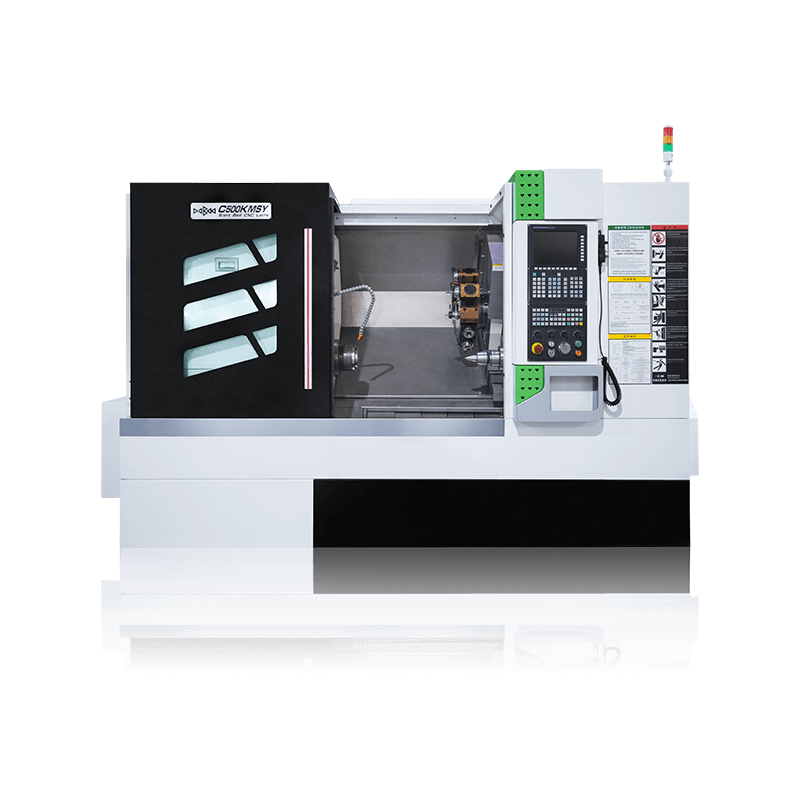
Eastern CNC Y-axis Live Tooling Lathe Recommendation: C500KMSY
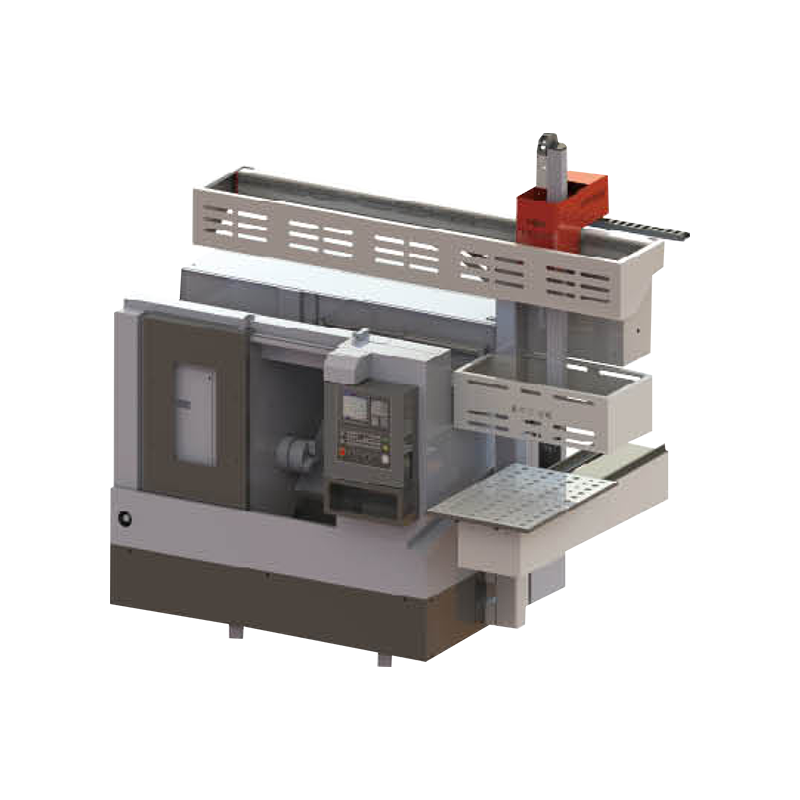
Among the many Y-axis live tooling lathe models available, the C500KMSY is a slant-bed CNC lathe specifically designed for heavy-duty cutting and complex part machining. It integrates both a Y-axis live tooling turret and a sub-spindle function, making it ideal for manufacturing scenarios requiring high precision and high complexity.
Key Configuration Highlights:
- Slant-Bed Structure: Features a high-rigidity slant-bed design that effectively absorbs vibrations generated during heavy cutting, ensuring long-term processing stability.
- Y-axis Live Tooling Turret: Equipped with an independent Y-axis servo system and ample travel range, supporting a full spectrum of complex machining operations—including the creation of eccentric holes, keyways, and face milling.
- Sub-Spindle Configuration: The sub-spindle automatically retrieves the workpiece from the main spindle once front-side machining is complete, allowing for back-side machining to finish the part in a single setup—eliminating the need for manual secondary fixturing.
- High-Efficiency Live Tooling System: The live tooling spindle speed is configured to meet the requirements of various operations—such as milling, drilling, and tapping—while ensuring high tool-changing efficiency.
- Optimized for Heavy Cutting: The spindle power and torque are specifically engineered for heavy-duty cutting applications across a wide range of materials—including steel, stainless steel, and non-ferrous metals—offering exceptional versatility.
The Y-axis live tooling lathe represents not merely an upgrade in mechanical structure, but a fundamental shift in manufacturing process logic—a systemic evolution from a paradigm of "multiple machines, multiple processes, and multiple setups" to one of "single machine, complex processes, and one-time completion." For precision manufacturing enterprises producing complex parts, the introduction of a Y-axis live tooling lathe often signifies a qualitative leap in machining capability. As high-end manufacturing sectors—such as medical devices and new energy vehicles—continue to expand, companies that take the in establishing Y-axis complex machining capabilities will secure a lasting competitive advantage across the three critical dimensions of precision, efficiency, and delivery time.



 English
 русский
 Español
 عربى
عربى 简体中文
简体中文
 2026.03.20
 Industry News