


 English
 русский
 Español
 عربى
عربى 简体中文
简体中文
Contact Us
All of your quotes will be answered within 2 hours by our professional sales support.
Industry News
 Home / News / Industry News / Multi-tasking Turret Lathes: A New Paradigm in Precision Manufacturing
  2026.04.03
 Industry News
Contents
The Multi-tasking Turret Lathe is a composite machining system that builds upon traditional CNC lathes by deeply integrating machining capabilities such as milling, drilling, and boring. Its core distinguishing feature lies in a turret system equipped with powered tooling capabilities; when combined with multi-axis simultaneous control, this enables "integrated turning, milling, and drilling"—a truly composite machining capability.
Key Architectural Logic: A high-rigidity machine bed + a powered turret system + a multi-axis CNC unit. These three components work in synergistic coordination, allowing a single machine to execute machining tasks that would traditionally require multiple separate processes and multiple distinct machines.
Each tool station is equipped with an independent servo motor, enabling the high-speed drive of rotary tools (such as milling cutters and drill bits). Spindle speeds typically range from 3,000 to 8,000 rpm, accompanied by precise torque control capabilities.
The C-axis facilitates the indexed rotation of the main spindle, while the Y-axis provides vertical feed offset. The coordinated movement of these two axes enables the milling of complex geometric features, such as eccentric holes, angled slots, and keyways.
Utilizing a hybrid bearing design that combines hydrostatic bearings with rolling element bearings, the headstock meets the dual requirements of heavy-duty cutting for turning operations and high-precision positioning for milling operations. Furthermore, an integrated thermal compensation system ensures the stability of machining accuracy during prolonged operation.
In terms of operating principles, the machine coordinates its various motion axes via a unified CNC controller: the main spindle handles the clamping and rotation of the workpiece (in turning mode) or precise indexing (in milling mode); the powered turret switches between machining processes according to the program; and the simultaneous interpolation of the X, Z, Y, and C axes executes the precision cutting of complex contours.
Compared to traditional single-function machine tools, multi-tasking turret lathes demonstrate systematic competitive advantages in the field of precision parts machining, spanning the three dimensions of accuracy, efficiency, and cost.
The workpiece remains clamped to the same datum throughout the entire process, thereby eliminating the repetitive positioning errors typically associated with transferring the part between multiple sequential operations. This results in a potential improvement of 30% to 50% in coaxiality and positional accuracy.
Non-value-added time—such as inter-process transfer, waiting, and secondary fixturing—is completely eliminated, typically shortening the total production cycle by 40% to 65%.
Single-piece flow or small-batch production allows parts to be completed directly, eliminating the need to circulate semi-finished goods within the workshop; this reduces capital tie-up and management complexity.
A single operator can manage multiple machines, thereby amortizing labor costs; simultaneously, investment in fixture design and maintenance is reduced, lowering indirect manufacturing costs.
Production changeovers are accomplished simply by switching programs and exchanging a few tools; this is ideally suited for order structures involving high-mix, low-to-medium volume batches, enabling rapid response to changing market demands.
Tool wear data is centrally collected and monitored; when integrated with a tool life management system, this effectively reduces the scrap rate caused by tool-related anomalies.
For complex parts featuring a combination of rotational surfaces, flat surfaces, and hole patterns, completing all machining processes in a single setup is one of the more valuable capabilities of a multi-tasking turret lathe.
| Setup & Positioning | OD Turning | Face/ID Machining | Powered Milling | Drilling & Tapping | Part Completion |
| Single Setup | Spindle Rotation | Boring & Threading | C/Y-Axis Interpolation | Multi-Position Holes | Direct Unloading |
| Datum Locking | OD Profiling | Internal Cavity Machining | Flat Surface/Slotting | Complex Hole Patterns | No Process Transfer Required |
The value of a single-setup strategy extends beyond mere efficiency. For parts with extremely tight geometric tolerance requirements—such as aerospace structural components, medical implants, and hydraulic valve bodies—completing all feature machining based on a single, consistent datum fundamentally prevents the accumulation of positional errors that typically occur during process transfers. In traditional multi-machine process chains, each transfer step can introduce a datum error of 5–15 μm—an error that proves particularly critical and detrimental for high-precision parts.
Typical Case Study: A hydraulic valve body part (featuring an outer diameter, multiple intersecting hole patterns, O-ring grooves, and flat face features). The traditional process requires three separate machines—a lathe, a machining center, and a drill press—and three distinct setups; quality degradation in this scenario occurs primarily during the transfer stages between machines. With a multi-tasking turret lathe, a part can be completed in a single setup, allowing hole position tolerances to be consistently controlled within ±0.01 mm.
The dual-turret lathe is a common solution for boosting efficiency, reducing cycle times by utilizing simultaneous machining via upper and lower turrets. In comparison, the multi-tasking lathe possesses a distinct set of capabilities and is suited to different application scenarios.
| Comparison Criteria | Dual-Turret Lathe | Multi-tasking Lathe |
| Machining Capability Range | Primarily turning; limited milling and drilling capabilities | Comprehensive coverage: Turning + Milling + Drilling + Boring; distinct advantage |
| Simultaneous Machining Efficiency | Dual-turret synchronization; high spindle utilization (Advantage) | Primarily single-turret operation, but process integration eliminates idle time |
| Adaptability to Complex Parts | Highly efficient for purely rotational parts | Significant advantage for complex parts featuring milling operations |
| Fixture Investment | Some operations still require transfer fixtures | Fixture requirements reduced by over 50% (Advantage) |
| Precision Consistency | Precision of transferred parts depends on fixture accuracy | Unified datum; higher systemic precision (Advantage) |
| Equipment Investment | Relatively low | Higher initial investment; Total Cost of Ownership (TCO) varies by product type |
| Ideal Application Scenarios | High-volume production of purely rotational turned parts | Medium-volume production of complex parts featuring milling and drilling operations |
In summary, the dual-turret lathe retains a cycle-time advantage for high-volume production of purely turned parts. However, when parts involve milling, eccentric holes, or irregular features, the multi-tasking lathe typically offers good overall efficiency—including factors such as quality loss and transfer costs—and often results in a lower Total Cost of Ownership (TCO) over the equipment's entire lifecycle.
When selecting equipment, manufacturing enterprises often face the decision of choosing among these three categories of machines. Understanding the specific capabilities and economic implications of each option is a prerequisite for making the right investment decision.
| Dimension | Standard CNC Lathe | Multi-tasking Lathe | Mill-Turn Machining Center |
| Primary Machining Type | Turning of Rotational Parts | Combined Turning + Milling + Drilling | Milling-centric with Auxiliary Turning |
| Milling Capability | Weak / None | Moderate to Strong | Strong |
| Turning Capability | Strong | Strong | Moderate |
| Adaptability to Complex Parts | Requires Coordination of Multiple Machines | More Features Completed on a Single Machine | Excels at Large, Complex Parts |
| Footprint | Small | Medium | Large |
| Equipment Cost | Low | Medium-to-High | High |
| Applicable Production Volume | High-Volume Standard Parts | Small-to-Medium Volume Complex Parts | Low-Volume, High-Complexity Parts |
| Programming Complexity | Low | Moderate | High |
To fully leverage the potential of a multi-tasking turret lathe, a systematic "single-setup" strategy must be formulated during the process planning phase, rather than relying solely on the hardware capabilities of the machine itself.
Classify features by machining type (external cylindrical surfaces, faces, internal bores, flat surfaces, hole patterns) and sequence them according to process logic: roughing before finishing, primary operations before auxiliary ones, and larger features before smaller ones. This ensures that each operation retains sufficient machining allowance and does not interfere with subsequent steps.
Prioritize the finish machining of positioning datum surfaces. Subsequent milling and drilling operations should all reference this unified datum to ensure that the positional accuracy between various features is traceable and controllable.
Cutting parameters for turning and milling differ significantly; therefore, the program must be carefully structured to manage spindle speed transition points, preventing vibrations or surface quality issues caused by parameter mismatches.
Continuous multi-operation machining generates a complex mix of chips. This necessitates the use of internal coolant systems and chip conveyors to prevent loose milling chips from interfering with turning operations, thereby ensuring a stable machining environment.
Critical dimensions are monitored in real-time during machining using an in-machine probe. This enables automatic compensation for tool wear and thermal deformation, achieving a closed-loop control cycle of "Machining—Measurement—Correction."
Multi-tasking turret lathes have become core machining equipment in numerous industries that demand exceptionally high standards for both precision and efficiency. The following provides an overview of their primary application scenarios.
Components such as hydraulic valve bodies, cylinder piston rods, and seal seats feature intricate systems of intersecting precision bores. Since the positional accuracy between these bores directly impacts sealing performance, a multi-functional turret lathe can effectively ensure the required coaxiality and perpendicularity of the bore system in a single machining operation.
Core transmission components—including differential cases, steering knuckles, and axle shafts—are characterized by complex geometries and high-volume production requirements. The multi-functional turret lathe balances both machining completeness and cycle time efficiency, making it ideally suited to meet the flexible production line demands of automotive Tier 1 suppliers.
For components such as wafer transfer mechanisms and precision optical mounts—which demand surface roughness levels of Ra 0.4 μm or finer—the multi-functional turret lathe leverages a combined process of precision turning and milling to achieve the ultimate accuracy specifications.
Large-scale precision rotary components—such as oil and gas drilling connectors, turbine blade roots, and valve bodies—often require both heavy-duty turning and complex milling capabilities. The multi-functional turret lathe provides an integrated platform capable of meeting these diverse and demanding requirements.
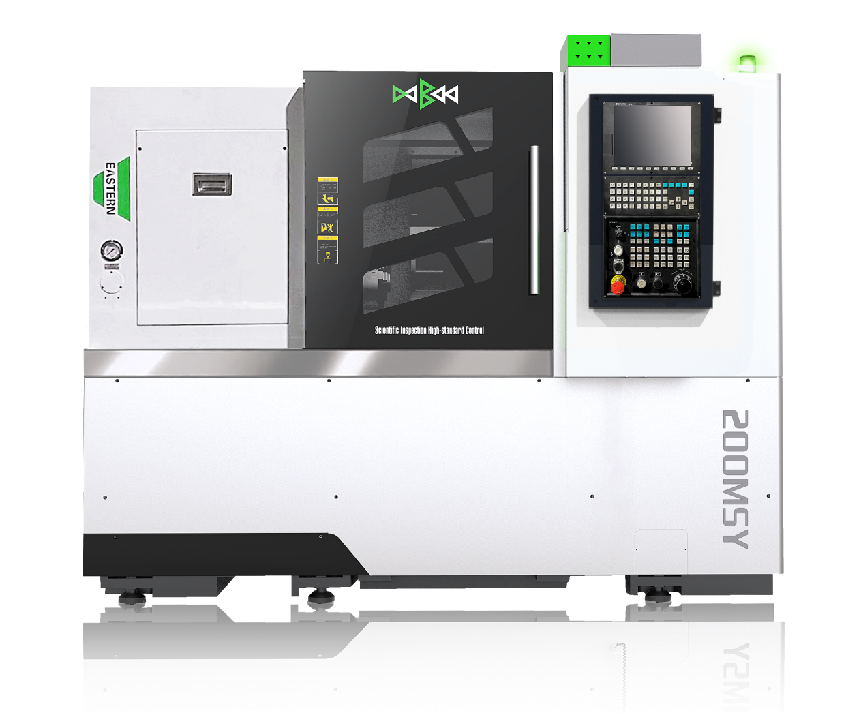
The 200MSY is a multi-functional turret lathe specifically designed for the medium-batch machining of complex parts. It integrates three core capabilities—M (Milling), S (Sub-spindle), and Y (Y-axis)—enabling the complete processing of bar-stock components, from raw material to finished product, in a single clamping setup. It represents a highly cost-effective solution for manufacturers seeking to upgrade their precision manufacturing capabilities.
RECOMMENDED PRODUCTS
All of your quotes will be answered within 2 hours by our professional sales support.
Use reliable parts and components to ensure product quality.
You can expect your order fulfilled within 60 days after placing the order.
All our products come with a one-year warranty.



sales@east-cnc.com

Shangma Industry Area, Shitang Town, Wenling City, Taizhou, Zhejiang, China.

Copyright © Taizhou Eastern CNC Technology Co., Ltd.

Machine Tool Manufacturer Privacy Policy