


 English
 русский
 Español
 عربى
عربى 简体中文
简体中文
Contact Us
All of your quotes will be answered within 2 hours by our professional sales support.
Industry News
 2025.09.05
 Industry News
Contents
A sub-spindle lathe is a type of CNC machine tool designed to expand the range of operations that can be performed in a single setup. In traditional CNC lathes, the main spindle holds the workpiece and performs turning operations. However, when complex parts require machining on both ends, the operator often needs to reposition the workpiece manually or move it to another machine. This interrupts workflow and increases handling time. The addition of a sub-spindle offers a solution by providing a secondary chuck that can hold, rotate, and process the opposite side of the workpiece.
The sub-spindle is a secondary spindle located opposite the main spindle in the machine. It is often mounted on a sliding axis so it can approach the main spindle, grab the workpiece, and retract to perform machining on the back side. In some configurations, the sub-spindle has the same speed range and power capacity as the main spindle, while in other designs it is slightly smaller. Its primary function is to reduce secondary setups, improve efficiency, and maintain alignment between front and back machining operations.
In a CNC sub-spindle lathe, machining usually begins on the main spindle. The workpiece is clamped, and front-side turning, drilling, or milling operations are performed. Once these are completed, the sub-spindle moves in, synchronizes rotation with the main spindle, and grips the part. After clamping, the part is cut off from the bar or blank, and the sub-spindle retracts to allow machining on the rear side. This process is often referred to as part transfer.
Modern machines integrate additional tools such as driven tool holders, Y-axis milling, and live tooling, making it possible to perform turning, milling, drilling, and tapping in a single cycle. This combination reduces setup times and improves accuracy because both ends of the workpiece are machined without removal from the lathe.
The presence of a sub-spindle brings greater flexibility to CNC turning centers. Manufacturers can produce complex components with fewer machines, less manual handling, and better consistency. For industries such as automotive, aerospace, and medical equipment manufacturing, this capability translates into reliable production of high-precision components.
The workflow is also smoother because the operator does not need to manually flip or reposition the part. With a sub-spindle, the lathe can automatically handle both ends, allowing for continuous cycles and unattended machining in some cases. This makes the machine suitable for medium and high-volume production environments.
It is important to distinguish between a twin spindle machine and a lathe with a sub-spindle. In a twin spindle design, both spindles may have equal capacity and are capable of operating simultaneously, often used in advanced multitasking machines. A sub-spindle lathe, on the other hand, primarily uses the secondary spindle for back-side machining and transfer operations. While both terms are sometimes used interchangeably, the difference usually lies in the level of balance between the two spindles and their intended purpose.
For more turning applications, a sub-spindle is sufficient to achieve front and back machining in one cycle. Twin spindle machines are more commonly applied when synchronized machining on two workpieces or complex parallel operations are required.
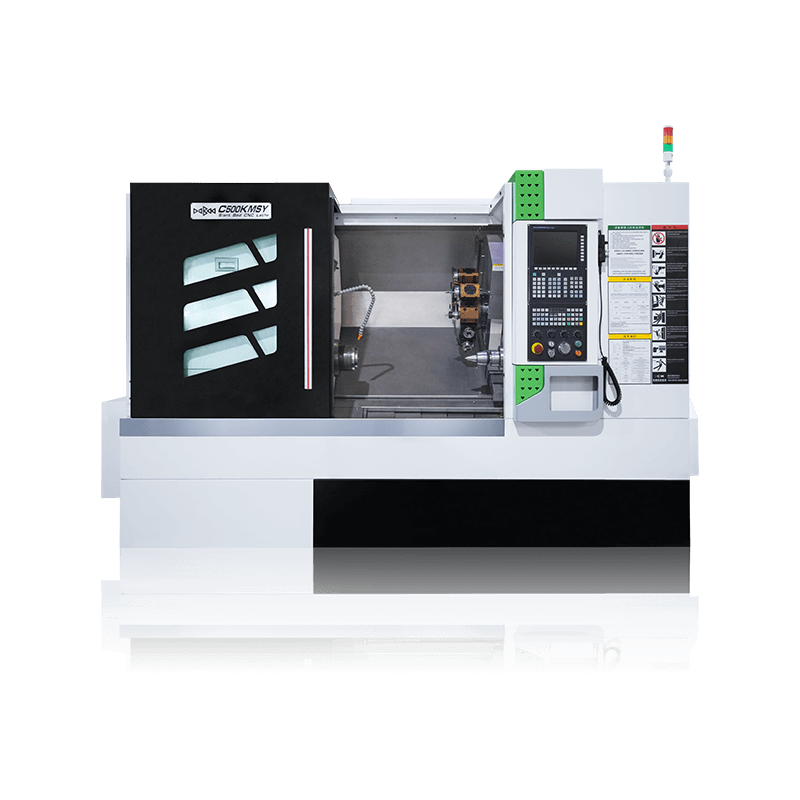
The Eastern CNC C500KMSY is a robust slant bed lathe engineered for heavy-duty machining. It features a 45° inclined bed and a circular, cast-iron structure, ensuring exceptional rigidity and effective chip removal. The machine is equipped with a 10-inch chuck, providing a maximum machining diameter of 430mm and a maximum machining length of 650mm, making it suitable for a wide range of applications.
Key specifications include a hydraulic servo turret or Y-axis lifted driven tool turret, offering high positioning accuracy and rapid tool changes. The spindle box is designed with high-rigidity double-row cylindrical roller bearings and bidirectional thrust angular contact bearings, which minimize thermal deformation and maintain spindle stability during prolonged operations.
RECOMMENDED PRODUCTS
All of your quotes will be answered within 2 hours by our professional sales support.
Use reliable parts and components to ensure product quality.
You can expect your order fulfilled within 60 days after placing the order.
All our products come with a one-year warranty.



Shangma Industry Area, Shitang Town, Wenling City, Taizhou, Zhejiang, China.

Copyright © Taizhou Eastern CNC Technology Co., Ltd.

Machine Tool Manufacturer Privacy Policy