


 English
 русский
 Español
 عربى
عربى 简体中文
简体中文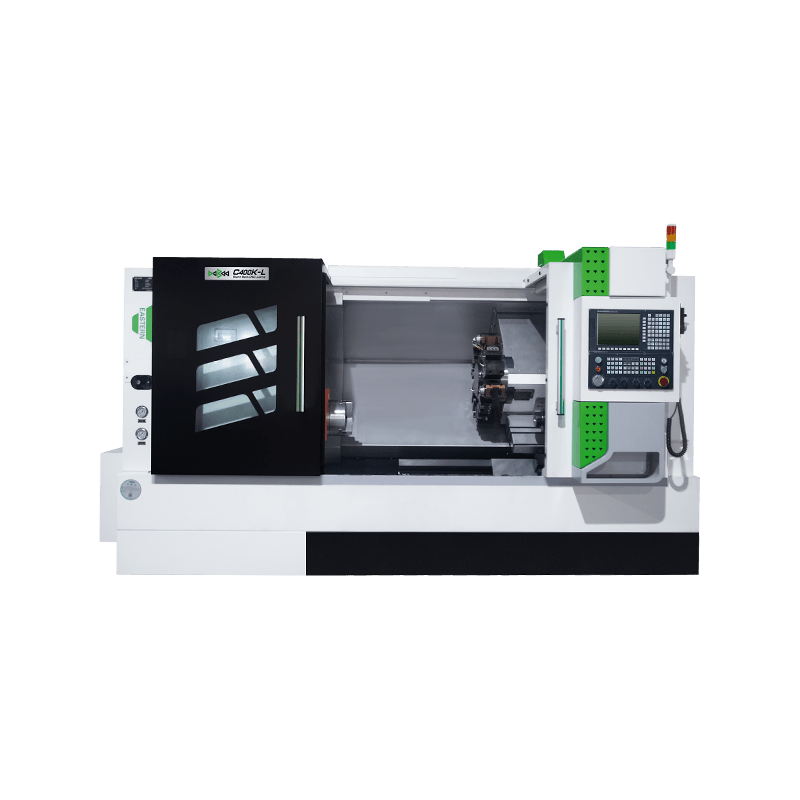
Contact Us
All of your quotes will be answered within 2 hours by our professional sales support.
Industry News
 Home / News / Industry News / Understanding The High And Low Rail Bed Cnc Lathe: Structure, Design, And Performance Insights
  2025.10.10
 Industry News
Contents
Cutting vibration on a cnc lathe is fundamentally a coupling between the tool–workpiece interaction and the machine’s structural modes. A bed with uneven stiffness or a long, lightly supported span can lower natural frequencies into the spindle–tool excitation range, encouraging regenerative chatter and poor surface finish. Designers therefore treat the bed as part of the dynamic system: Increasing local stiffness and adding damping or tuned mass elements raises modal frequencies and reduces resonant amplitude—helping the machine keep stable cutting conditions at practical feed and depth settings. Slant/angled beds commonly used in modern lathe families also assist chip evacuation and change modal shapes, which can reduce some vibration modes.
A high-low rail bed (sometimes called double-rail or stepped bed) seeks to concentrate material where it contributes more to stiffness while trimming weight elsewhere. Key strategies: Use a thicker high rail directly under the carriage to maximize section modulus where bending moments are largest; use a lower, broader low rail for shear and to stabilize the overall cross section; apply ribbed internal geometry to increase second moment of area without adding solid mass; and choose cast or welded structures with internal damping features (e.g., rib networks, tuned dampers). Finite-element modal and static analyses during design let engineers shift metal from low-strain regions into high-strain zones, achieving a pragmatic compromise between rigidity and mass.
The high rail typically carries the carriage ways and absorbs the primary vertical and bending loads from cutting. It needs a hardened, wear-resistant guide surface and higher local stiffness. The low rail’s role is to resist torsion, provide lateral stability, and serve as a reaction path for the bed’s overall bending. Under heavy cutting, the high rail sees concentrated rail contact loads while the low rail distributes global bending and shear across a wider footprint; both must be designed together to control relative deflection and maintain tool-center accuracy.
In actual production, the performance of high-low rail lathes depends on how well the mechanical layout aligns with application needs. Machines with a moderate rail height difference often achieve a good balance between rigidity and accessibility. Meanwhile, larger rail offsets may enhance vibration damping but require more complex alignment systems. Industry feedback suggests that such designs are especially beneficial for heavy-duty cutting, precision shafts, and large-diameter components, as they maintain stable performance under varying loads.
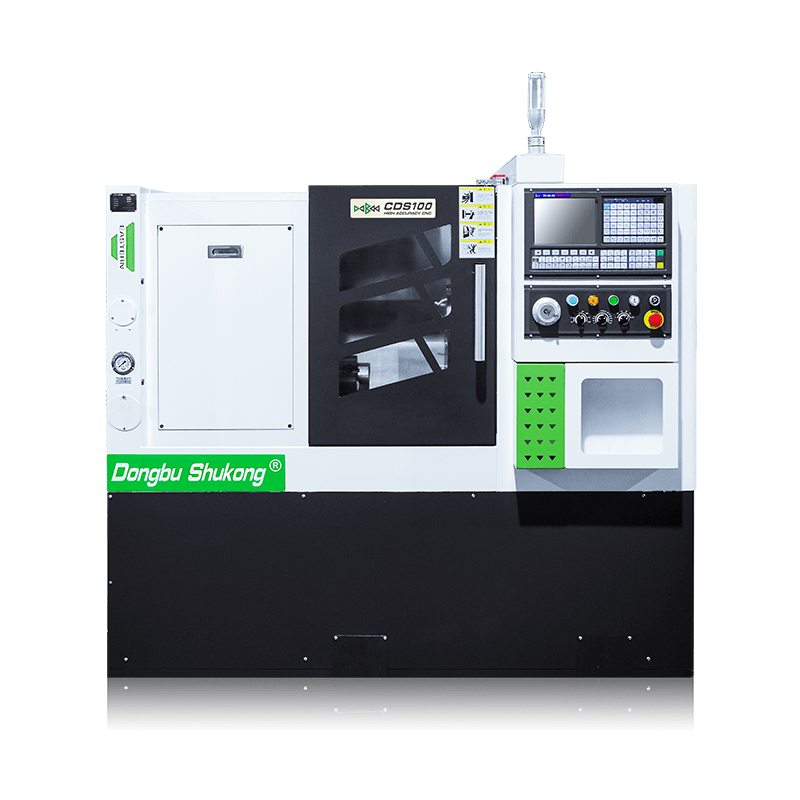
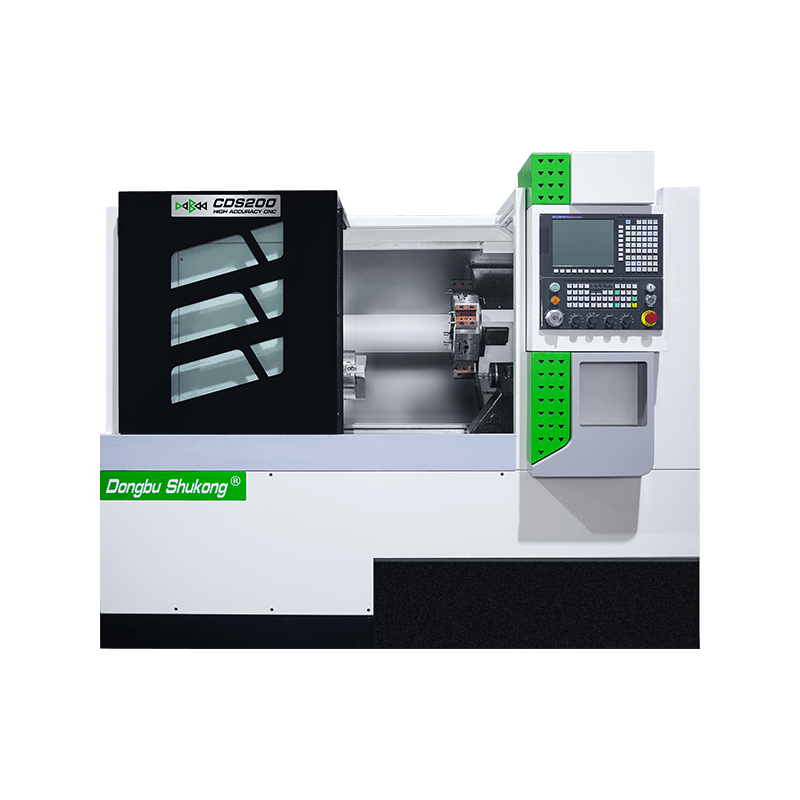
Two representative models from the CDS100 and CSD200, showcase different interpretations of the high-low rail concept.
|
Model |
Swing Over Bed |
Max Turning Length |
Spindle Bore |
Bed Structure |
Notable Feature |
|
CDS100 |
400 mm |
750 mm |
52 mm |
Cast Iron High-Low Rail |
Compact, Precise Motion System |
|
CDS200 |
630 mm |
1500 mm |
82 mm |
Reinforced High-Low Rail |
Enhanced Damping And Load Stability |
Both models employ carefully analyzed ribbed bed structures and linear guide systems that support steady, long-term machining. The CDS100 emphasizes compact design for general precision parts, while the CDS200 targets heavier applications where additional rigidity is beneficial.
The high and low rail bed CNC lathe represents a refined balance of strength, vibration control, and operational stability. Through thoughtful design and material engineering, this structure continues to receive positive recognition across various machining industries. Models like the CDS100 and CDS200 demonstrate how optimized bed geometry can directly contribute to machining consistency, longer tool life, and overall production reliability.
RECOMMENDED PRODUCTS
All of your quotes will be answered within 2 hours by our professional sales support.
Use reliable parts and components to ensure product quality.
You can expect your order fulfilled within 60 days after placing the order.
All our products come with a one-year warranty.



sales@east-cnc.com

Shangma Industry Area, Shitang Town, Wenling City, Taizhou, Zhejiang, China.

Copyright © Taizhou Eastern CNC Technology Co., Ltd.

Machine Tool Manufacturer Privacy Policy