


 English
 русский
 Español
 عربى
عربى 简体中文
简体中文
Contact Us
All of your quotes will be answered within 2 hours by our professional sales support.
Industry News
 Home / News / Industry News / Why have flat-bed CNC lathes once again become the good choice for heavy-duty cutting operations?
  2026.05.15
 Industry News
Contents
In recent years, driven by the surging demand for machining ultra-large components across heavy industrial sectors—such as wind turbine spindles, nuclear power rotors, large marine crankshafts, and mining machinery—flat-bed CNC lathes (specifically, heavy-duty flat-bed CNC lathes) are making a powerful comeback to the center stage of heavy-duty cutting operations, thanks to their exceptional rigidity, massive load-bearing capacity, and good deep-cutting capabilities.
In the realm of CNC lathes, the slant-bed structure has long been highly favored for its convenient chip evacuation and high degree of automation, holding a dominant position—particularly in scenarios involving the precision finishing and mass production of small-to-medium-sized parts. However, an undeniable fact remains: while the inclined angle of a slant-bed structure facilitates chip runoff, it inherently imposes limitations on both its structural rigidity and the big diameter of the workpieces it can accommodate.
When workpiece diameters exceed φ500mm and weights surpass 1 ton, the inherent limitations of slant-bed lathes begin to manifest. It is precisely at this juncture that the structural advantages of flat-bed CNC lathes—specifically, heavy-duty flat-bed CNC lathes—truly come to the fore.
A flat-bed CNC lathe (also referred to as a flat-bed CNC turning machine or horizontal heavy-duty CNC lathe) is defined as a CNC lathe in which the guide surfaces of the machine bed are arranged horizontally. Its saddle and tool post traverse horizontally, while the headstock is fixed at one end of the bed; it represents the modernized, CNC-driven evolution of the traditional horizontal lathe.
In contrast to slant-bed lathes, flat-bed lathes prioritize overall structural rigidity, the ability to securely clamp large-diameter workpieces, and the capacity to withstand immense cutting forces. Consequently, this design has emerged as the predominant structural configuration within the specialized niche of heavy-duty flat-bed CNC lathes.
| Comparison Dimension | Flat-bed CNC Lathe | Slant-Bed CNC Lathe |
| Bed Structure | Horizontally positioned; integral cast iron construction with high rigidity | 45°/60° inclined; relatively lower rigidity |
| Load-Bearing Capacity | Ultra-heavy-duty; capable of handling tens of tons | Medium-to-light-duty; generally within 3 tons |
| Cutting Depth | Large single-pass depth of cut | Limited cutting depth |
| Workpiece Diameter | φ800mm – φ3000mm+ | Primarily φ80mm – φ500mm |
| Chip Removal Method | Requires a dedicated chip removal system | Automatic gravity-assisted chip removal |
| Applicable Scenarios | Heavy industry; large-scale parts | Batch finishing of small-to-medium-sized parts |
| Maintenance Costs | Long guide rail lifespan; low overall maintenance costs | Faster wear due to high-speed operation |
As clearly evident from the table above, when dealing with heavy-duty workpieces characterized by large diameters, high hardness, and substantial machining allowances, heavy-duty flat-bed CNC lathes possess distinct structural advantages. They are by no means replaceable by simple upgrades to slant-bed lathes.
As global carbon neutrality goals advance, the installed capacity for wind power generation continues to climb. Core wind power components—such as main shafts, flanges, and hubs—typically feature diameters exceeding φ1000mm and weigh several tons, or even over ten tons; furthermore, they demand extremely high standards for roundness and surface finish. Such components naturally constitute the core application scenario for heavy-duty flat-bed CNC lathes.
Take a domestic wind turbine manufacturer as an example: a single wind turbine main shaft blank weighs a staggering 8 tons, with a machining allowance exceeding 60mm. This places extremely rigorous demands on the machine tool's cutting force endurance and bed rigidity. Standard CNC lathes are simply incapable of handling such tasks; consequently, heavy-duty flat-bed CNC lathes emerge as the only viable option.
Core components—such as nuclear reactor pressure vessels, steam generator tube sheets, and large-scale petrochemical heat exchanger tube sheets—often feature processing diameters exceeding φ1500mm and are subject to extremely stringent requirements regarding precision and safety. Heavy-duty CNC flat-bed lathes, leveraging their high-rigidity spindle systems and precision rolling/hydrostatic guide ways, are capable of meeting the ultra-precision machining demands of these high-value-added components.
Components found in mining machinery—such as drums, large slewing bearings, and hoist drums—as well as those in construction machinery—such as large hydraulic cylinder barrels and turntables—represent traditional strongholds for heavy-duty CNC flat-bed lathes. Driven by the sustained momentum of the "infrastructure boom" and the growing demand for mineral resources, the scale of machine tool procurement within this specific market segment continues to expand.
Large-scale components for marine vessels—such as crankshafts, propeller shafts, and stern tubes—can reach lengths of several meters and diameters exceeding φ600mm; these represent one of the more quintessential applications for heavy-duty CNC flat-bed lathes. In recent years, the global shipping market has experienced a resurgence; the resulting increase in shipbuilding orders has directly stimulated the demand for supporting machine tools.
Heavy-duty CNC flat-bed lathes typically feature a bed constructed from integral cast iron or resin-bonded sand castings. Following stress-relieving annealing treatment, the bed undergoes precision hand-scraping to ensure the guide ways possess exceptional rigidity. When processing high-hardness materials (such as super-hard alloys or quenched steel), the machine can withstand cutting forces reaching tens of kilonewtons without exhibiting significant vibration, thereby ensuring machining precision.
The spindle motors on heavy-duty CNC flat-bed lathes typically range in power from 45 kW to over 200 kW, generating spindle torque that can reach tens of thousands of N·m. This capability enables the machine tool to maintain powerful cutting torque even at low rotational speeds, thereby satisfying the requirements for rough and semi-finish machining of large-diameter cast steel and forged steel components.
High-end, heavy-duty flat-bed CNC lathes utilize liquid hydrostatic guides—or a hybrid combination of hydrostatic and rolling guides—to maintain micron-level motion precision while supporting the immense weight of heavy workpieces. This effectively eliminates "stick-slip" (crawling) phenomena, thereby providing a solid foundation for ensuring precision during the finish machining stage.
With the deep integration and adaptation of mainstream CNC systems—such as Huazhong CNC, Guangzhou CNC, Siemens 840D, and FANUC 31i—into heavy-duty machine tools, the level of automation, programming convenience, and remote monitoring capabilities of heavy-duty flat-bed CNC lathes have improved significantly. This has further lowered operational barriers and reduced production management costs.
east-cnc.com | Specializing in Heavy-Duty CNC Machine Tool Manufacturing
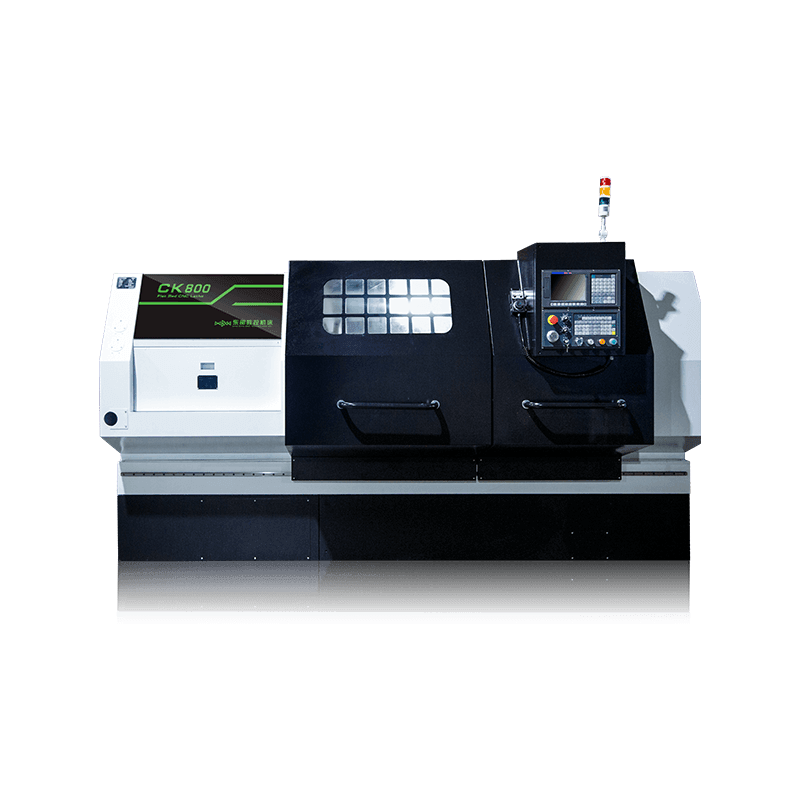
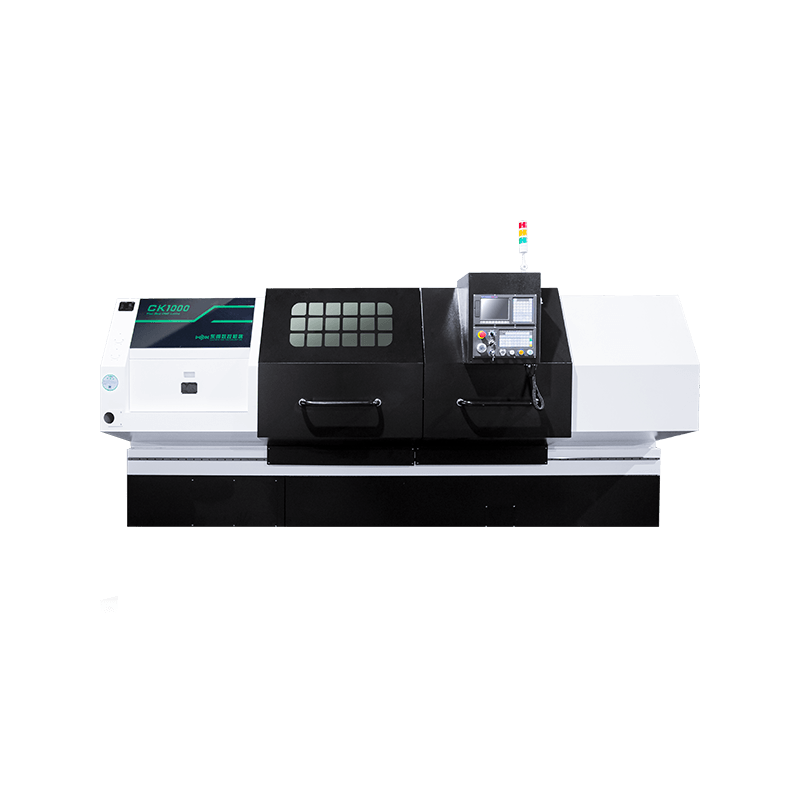
Eastern CNC (east-cnc.com) is a specialized domestic manufacturer in the field of heavy-duty CNC machine tools. With years of dedicated expertise in the R&D and manufacturing of flat-bed CNC lathes, the company's CK800 and CK1000 series heavy-duty flat-bed CNC lathes have been widely adopted across various heavy industries—including wind power, nuclear power, shipbuilding, and mining machinery—earning the trust of numerous industry-leading clients.
| Product Model | CK800 |
| Max. Swing Diameter | φ800mm (Over Bed) |
| Max. Machining Length | 1500mm – 6000mm (Customizable) |
| Spindle Motor Power | 45kW – 75kW |
| Spindle Speed Range | 2 – 800 rpm (Infinitely Variable Speed) |
| Max. Load Capacity | ≤ 5000 kg |
| CNC System | FANUC / SIEMENS / HNC (Optional) |
| Guide Rail Type | Rectangular Guide Rails + Plastic-Coated Surface (Wear-resistant, High Rigidity) |
| Applicable Industries | Wind Power Spindles, Chemical Vessel Flanges, Mining Drums, Hydraulic Cylinder Blocks, etc. |
| Product Model | CK1000 |
| Max. Swing Diameter | φ1000mm (Over Bed) |
| Max. Machining Length | 2000mm – 8000mm (Customizable) |
| Spindle Motor Power | 75kW – 132kW |
| Spindle Speed Range | 1 – 600 rpm (Infinitely Variable Speed) |
| Max. Load Capacity | ≤ 12000 kg |
| CNC System | FANUC / SIEMENS 840D (Optional) |
| Guide Rail Type | Wide Rectangular Cast Iron Guide Rails + Hydrostatic System (High-end configuration option) |
| Applicable Industries | Nuclear Power Rotors, Marine Crankshafts, Wind Power Spindles, Precision Finishing of Large Rotary Components |
RECOMMENDED PRODUCTS
All of your quotes will be answered within 2 hours by our professional sales support.
Use reliable parts and components to ensure product quality.
You can expect your order fulfilled within 60 days after placing the order.
All our products come with a one-year warranty.



sales@east-cnc.com

Shangma Industry Area, Shitang Town, Wenling City, Taizhou, Zhejiang, China.

Copyright © Taizhou Eastern CNC Technology Co., Ltd.

Machine Tool Manufacturer Privacy Policy