


 English
 русский
 Español
 عربى
عربى 简体中文
简体中文
Contact Us
All of your quotes will be answered within 2 hours by our professional sales support.
Industry News
 2026.05.22
 Industry News
Contents
Thanks to their unique vertical spindle configuration, Vertical Turret Lathes (VTLs) have become indispensable core equipment for machining large, heavy, and rotationally symmetrical workpieces. Unlike horizontal lathes, VTLs utilize a horizontally rotating worktable rather than a rotating spindle; workpieces are securely anchored to the table by their own gravity, thereby significantly minimizing the risk of deformation during clamping. This makes them particularly well-suited for the precision machining of disc-shaped, ring-shaped, and short-shaft components ranging in diameter from 500 mm to tens of meters, and in weight from hundreds of kilograms to hundreds of tons.
Driven by strategic carbon neutrality goals, the global installed capacity for wind power continues to soar. The core structural components of wind turbine generator sets—including hubs, main bearing housings, yaw bearing rings, pitch bearing rings, and tower flanges—all rely on vertical lathes for high-precision machining.
Key Workpieces and Processing Requirements
Large-scale vertical lathes (featuring worktables with diameters ≥ 5 meters)—when integrated with CNC systems and in-process inspection devices—enable the "single-setup, multi-process compound machining" of core wind power components, thereby significantly enhancing both consistency and efficiency. Statistics indicate that utilizing a 5-axis vertical machining center to process wind turbine hubs boosts overall machining efficiency by over 40% compared to traditional processing methods.
Industries such as petrochemicals, nuclear power, and LNG (Liquefied Natural Gas) impose rigorous requirements regarding the sealing integrity and dimensional precision of large-diameter, high-pressure valves. Core components—including valve bodies, bonnets, and seats—are prime candidates for machining on vertical lathes due to their complex internal cavity structures and large physical dimensions.
Key Process Features
Specialized valves—such as nuclear-grade butterfly valves and gate valves—demand extremely high standards regarding the machinability of their materials (e.g., duplex stainless steel and Inconel alloys). Modern CNC vertical lathes, equipped with servo tool turrets and high-pressure coolant systems, effectively manage cutting heat to ensure both the dimensional stability and corrosion resistance of the finished components.
As critical standardized components for connecting pipes, pressure vessels, and mechanical equipment, flanges require a level of machining quality that directly impacts the sealing integrity and safety of the entire system. Vertical lathes represent the ideal choice for the mass production of precision flanges, being particularly well-suited for machining large-diameter flanges with an outer diameter exceeding 500 mm.
Typical Machining Specifications and Processes
As the process industry expands into deep-sea, high-pressure, and highly corrosive environments, flange specifications are continuously evolving toward larger dimensions and higher pressure ratings. This trend imposes increasingly stringent demands on the rigidity, thermal stability, and CNC precision of vertical lathes. Intelligent vertical lathes equipped with integrated laser measurement systems have successfully achieved closed-loop quality control in flange manufacturing.
Extra-large bearings (Outer Diameter: >500 mm)—such as main bearings for tunnel boring machines (TBMs), wind turbines, and rotary kiln support rollers—rank among the components with the high technical barriers within the realm of heavy machinery. Vertical lathes are tasked with the precision machining of bearing rings (inner and outer diameters), end faces, and raceways; this constitutes a decisive stage in determining the ultimate quality of the bearing.
Key Process Metrics
Leading domestic bearing manufacturers have widely adopted high-precision CNC vertical lathes equipped with temperature compensation capabilities. By integrating oil-air lubricated spindles and linear encoder closed-loop feedback systems, they have elevated the turning precision of large bearing rings to the IT5 grade, thereby ensuring the uniformity of the grinding allowance for subsequent grinding operations.
The aerospace sector imposes exceptionally stringent requirements regarding part dimensional accuracy, surface integrity, and material properties. In this field, vertical lathes are primarily utilized for the precision machining of rotational components—such as large frame rings, engine casings, landing gear bushings, and spacecraft docking rings.
Typical Components and Challenges
Aerospace-grade vertical machining centers are equipped with 5-axis simultaneous control capabilities, spindle speeds exceeding 15,000 rpm, thermal compensation systems, and in-situ measurement functions; furthermore, they hold AS9100 aerospace quality system certification. Some top-tier manufacturers have already integrated AI-assisted cutting parameter optimization systems into their vertical lathe controllers, enabling tool life prediction and adaptive machining.
Core energy components—such as nuclear power plant pressure vessels, steam generator tube sheets, steam turbine rotors, and large-scale pumped-storage hydropower runners—represent the pinnacle of manufacturing capability for vertical lathes. These parts typically exhibit a triple set of characteristics: massive dimensions (diameters ranging from 5 to 15 meters), weight (tens to hundreds of tons), and ultra-high precision (at the micrometer level).
Representative Applications
Vertical lathes utilized for energy equipment are typically customized, heavy-duty, or ultra-heavy-duty machines, featuring worktables with load capacities ranging from 100 to 500 tons. The combination of hydrostatic guideways, heavy-duty servo tool turrets, and multi-axis CNC systems ensures machining stability and sustained precision even under load conditions.
Excavators Core components for heavy machinery—such as slewing bearings, shield machine cutterhead drive rings, port crane slewing platforms, and mining dump truck hubs—place substantial demands on the machining capabilities and efficiency of vertical lathes. Parts in this sector are characterized by large production batches and materials predominantly consisting of high-strength cast steel, necessitating exceptionally strict requirements regarding machining cycle times and equipment stability.
Leading domestic heavy machinery manufacturers (such as XCMG, Sany, and Zoomlion) have extensively deployed flexible production lines utilizing CNC vertical lathes. Leveraging MES (Manufacturing Execution Systems) to enable real-time traceability of machining data, these companies have achieved significant improvements in both product consistency and delivery efficiency.
A comprehensive overview of application practices across seven major industrial sectors reveals that vertical lathes are undergoing a profound transformation—evolving from mere "standalone precision machining tools" into "core nodes within intelligent manufacturing systems." The integrated application of digital twin technology, AI-assisted machining, the Industrial Internet, and eco-friendly cutting techniques will further expand the operational capabilities and boundaries of vertical lathes.
For manufacturing enterprises, the key pathway to securing a competitive edge in today's fierce market lies in selecting vertical lathe specifications that precisely match their business requirements (including table diameter, load capacity, precision grade, and number of controlled axes), and subsequently integrating automation and digitalization tools to construct intelligent machining cells.
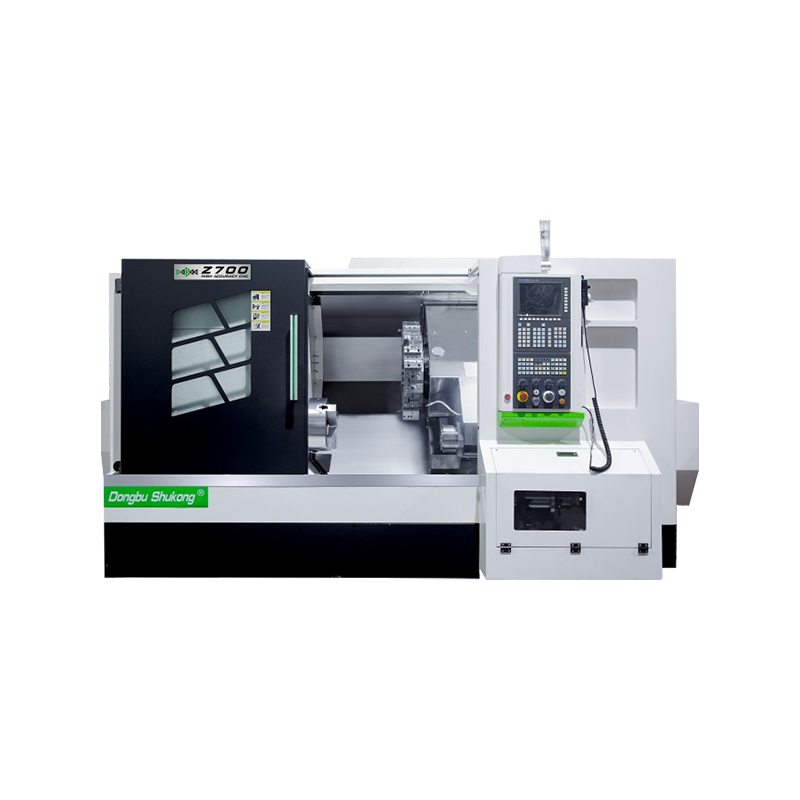
Introduced by Taizhou Eastern CNC Technology Co., Ltd., the VTC65 CNC Vertical Lathe is a vertical turning center specifically engineered for the high-precision machining of complex workpieces, particularly those of a disc-like or short-shaft configuration. With a machining diameter of 650mm, and equipped with a hydraulic servo turret and hydraulic chuck, the machine features a high-rigidity, high-precision structural design. This robust construction enables it to meet the rigorous machining demands across seven core industrial sectors: wind power, valves, flanges, bearings, aerospace, energy, and construction machinery.
High-Rigidity Structural Design
The machine bed is integrally cast from high-strength cast iron. The internal rib layout has been optimized through Finite Element Analysis (FEA), and—combined with precision roller linear guides—this design effectively suppresses cutting vibrations, thereby ensuring the long-term stability of machining accuracy.
Hydraulic Servo Turret
Equipped as standard with an 8-station hydraulic servo turret, the tool changer offers rapid response times and precise positioning. It supports continuous cutting across multiple operations—including external and internal turning, facing, taper forming, and internal bore machining—significantly reducing auxiliary processing time and boosting overall machining efficiency.
High-Torque Spindle System
Featuring a main motor power of 15/18.5 kW and a spindle speed range of 50–1250 rpm, the system is characterized by high torque at low speeds. This attribute makes it particularly well-suited for heavy-duty cutting of difficult-to-machine materials—such as cast steel, stainless steel, and titanium alloys—effectively meeting the dual requirements of both rough and finish machining.
RECOMMENDED PRODUCTS
All of your quotes will be answered within 2 hours by our professional sales support.
Use reliable parts and components to ensure product quality.
You can expect your order fulfilled within 60 days after placing the order.
All our products come with a one-year warranty.



sales@east-cnc.com

Shangma Industry Area, Shitang Town, Wenling City, Taizhou, Zhejiang, China.

Copyright © Taizhou Eastern CNC Technology Co., Ltd.

Machine Tool Manufacturer Privacy Policy