


 English
 русский
 Español
 عربى
عربى 简体中文
简体中文
Contact Us
All of your quotes will be answered within 2 hours by our professional sales support.
Industry News
 Home / News / Industry News / Slant-Bed Angles: 30° vs 45° vs 60° — What the Numbers and Practice Show
  2025.11.14
 Industry News
Contents
Slant-bed machine tools (commonly in CNC turning centres) are built with the bed (and often the guide-way/rail system) inclined at a certain angle relative to the horizontal. Typical angles include 30°, 45°, and 60°, each offering different trade-offs in rigidity, chip evacuation, and suitability for workpiece size and machine layout.
The slant angle affects how the machine structure resists the cutting forces of turning/boring.
With the bed inclined, the guide-ways and machine casting can form a more favourable structural “triangle” or slanted structure, improving bending and torsional stiffness compared to a flat-bed.
For example, studies show that when the bed is angled between 30°–45°, rigidity may improve by about 18–22 % (compared to a flat bed) and vibration amplitudes in heavy cutting can drop by ~40 %.
Practically, many users report that a 45° slant offers notably better structural rigidity than a 30° slant.
Comparison:
30°: More modest angle; still provides slant-bed advantages over flat, but somewhat less beneficial in heavy cutting/ridged loads.
45°: Often regarded as a “good compromise” offering improved rigidity while maintaining practical layout. Many heavy-duty machines adopt a 45° angle.
60°: Even steeper angle, meaning the structural casting can be extremely rigid and well-suited for high cutting loads/large workpieces (though fewer references).
Thus, if rigidity and heavy cutting are priorities, a steeper bed angle (45° or even 60°) tends to be preferred.
Another important benefit of slanted beds is the gravity-assisted chip flow and coolant drainage/flow. Because the bed slopes, chips fall more readily away from the cutting zone, reducing accumulation, improving coolant flow and reducing tool wear.
Key data/observations:
One source reports that slant-bed designs yield chip evacuation speeds of around 2.5 m/s, whereas flat-bed designs see about 1.2 m/s.
Chip clogging frequency for slanted beds may drop to ~1 incident per 40 hrs, versus ~1 incident per 12 hrs for flat-bed in one trial.
Work-piece size/cooling: With better chip flow, coolant can more effectively reach the tool/workpiece interface, improving tool life and surface quality.
Angle effect:
At 30°, the slant helps chip removal significantly compared to flatbed, and is adequate for moderate loads.
At 45°, the steeper angle further enhances chip fall-away and coolant drainage — making it especially favourable for heavy cutting or high-volume production where chip removal is critical.
At 60°, chip removal and coolant drainage performance are even more pronounced (gravity-assisted flow becomes stronger), which benefits large parts, heavy-duty roughing, and environments where chip accumulation is a major concern.
Thus, steeper slants correlate with better chip/coolant behaviour in many practical scenarios.
The angle of the bed also influences how the machine occupies floor space, how parts are loaded/unloaded, and what kind of work-pieces are good suited. Many guides note: for smaller/medium-sized workpieces and more compact machine footprints, a 30° slant is common; for heavier/bigger parts the steeper angles make more sense.
| Slant Angle | Typical Use-Case | Layout/Footprint Characteristics |
| 30° | Medium/small work-pieces, general machining | Lower height rise, more compact machine footprint; good general versatility |
| 45° | Balanced heavy/medium work-pieces, higher performance | Good compromise: increased tool/workpiece capacity without excessive footprint increase |
| 60° | Large work-pieces, heavy cutting loads, roughing operations | Steeper bed may mean taller machine, but supports large diameter/longer parts and heavy tool loads |
For example, one guide states that 30° beds suit compact parts well, 45° models offer a good balance, and 60° machines “excel in heavy-duty machining”.
When choosing among a 30°, 45°, or 60° slant-bed machine, manufacturers and users should weigh three interconnected factors:
1. Rigidity and cutting-force resistance – steeper angles favour higher rigidity and reduced vibration under heavy loads.
2. Chip evacuation and cooling efficiency – steeper mounts provide stronger gravity-assisted evacuation and coolant flow.
3. Workpiece size and machine layout – smaller jobs and compact layouts may suit 30°, while large-scale heavy-duty parts benefit from 45° or 60°.
In practice, many shops adopt 45° as the “sweet-spot,” offering a solid balance of performance, layout, and versatility. Meanwhile, 30° remains a versatile choice for general machining and smaller part sizes, and 60° is reserved where heavy loads, large parts, and high chip volumes demand the big structural/evacuation advantages.
In today’s competitive manufacturing environment, aligning the slant-bed angle with the production objectives (tool loads, chip volumes, part size, machine footprint) is increasingly critical to maximize throughput, tool life, and process stability.
One of the often-overlooked advantages of slant-bed design lies in tool arrangement and X-axis stroke efficiency. Because the bed and carriage are inclined, the machine can offer a longer usable X-direction travel within the same overall width, giving more flexibility for multi-tool turrets, live tools, or large-diameter turning.
30° Slant Bed: Compact layout suitable for smaller turrets or simpler two-station tool blocks; X-axis range typically moderate.
45° Slant Bed: Balanced geometry allows larger turrets and extended X-axis stroke—commonly 20–25 % longer than 30° machines—supporting multi-tool configurations without enlarging the machine footprint.
60° Slant Bed: Steeper incline maximizes clearance between tool post and workpiece, ideal for heavy radial cutting or large-diameter parts requiring multiple tool setups.
In short, as the slant angle increases, tool accessibility, interference avoidance, and machining flexibility all improve significantly.
 |
 |
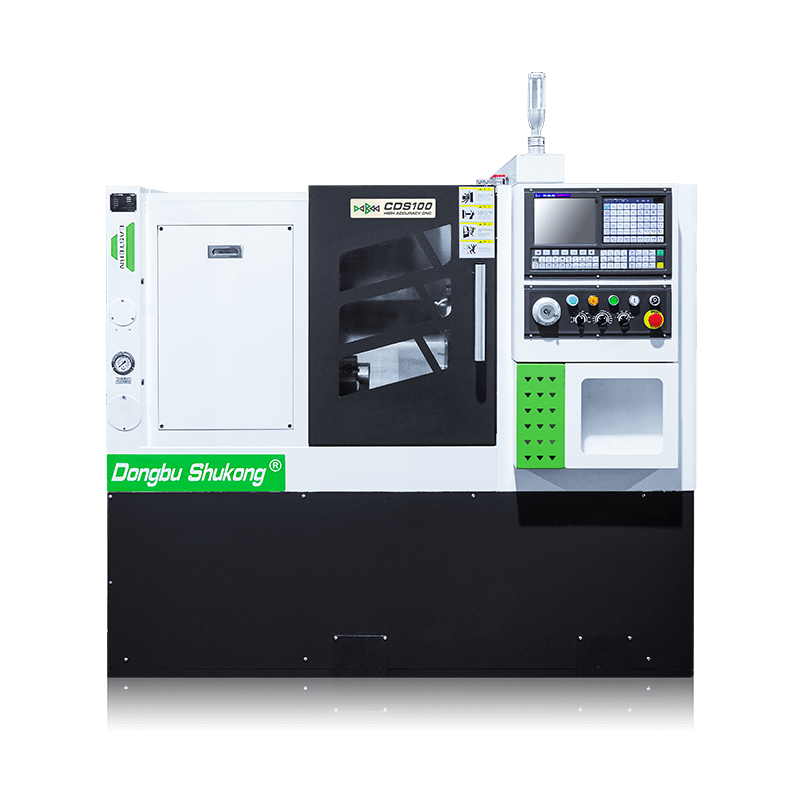
Application: Smaller/medium work-pieces, space-constrained layout; good chip removal and compact footprint.
Example specs: Max swing over bed φ450 mm, spindle speed up to 5000 rpm in CDS100.
Recommendation: If your shop does mostly smaller shafts, plates, or needs a compact layout, this 30° bed model is appropriate.
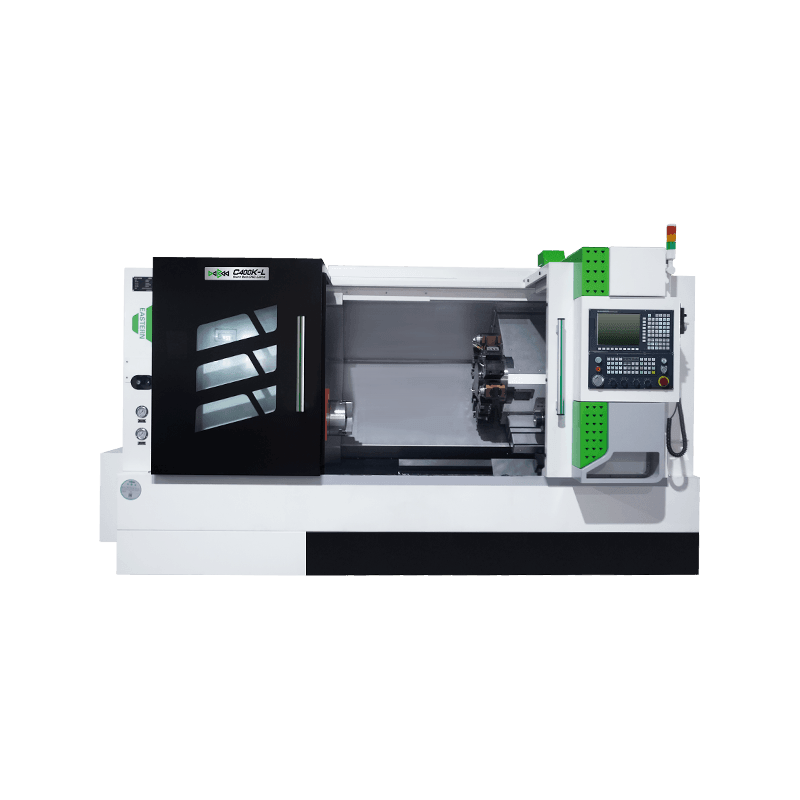
inclined bed and circular cavity cast iron structure to ensure heavy cutting capabilities.
Application: Balanced performance—improved rigidity, better chip evacuation than 30°, suitable for medium to heavier workpieces.
Recommendation: If you run heavier cuts, higher volumes, and need the sweet spot of performance and layout, a 45° slant bed from Eastern CNC is a good match.
1. What is the actual bed angle of the machine tool? How does it affect rigidity and chip removal?
Understanding whether the machine tool's bed angle is 30°, 45°, or steeper helps you match your workload, a steeper angle provides better rigidity (suitable for heavy cutting) and chip removal performance (suitable for high-volume production), but may affect the footprint and ergonomics of loading and unloading operations.
2. What is the big size of the workpiece (diameter on the bed, rotation diameter on the slide, machining length)?
This helps ensure the machine tool matches your part dimensions. For example, the Eastern CNC CDS100 (30°) has a bed rotation diameter of φ450 mm.
3. What are the standard tool/turret configurations (tool positions, powered tools, subspindle)?
For increased flexibility, some models are equipped with 8-12 station turrets, hydraulic through-type chucks, etc.
4. How is chip removal and coolant flow designed in this slant bed configuration?
Because slant bed machines utilize gravity for chip removal, inquiries are needed regarding the chip conveyor location, bed inclination angle, coolant delivery, and filtration.
5. What is the design of the guideways and bed casting? How does it improve rigidity and thermal stability?
Rigidity and accuracy depend on the bed casting, high/low guideway design, and materials.
6. What are the machine tool's footprint and layout requirements in the workshop?
A steeper slant bed may increase machine height or change the operating angle. You need to check the loading/unloading, chip conveyor location, and whether it fits your site space.
7. What support and after-sales services does the manufacturer provide (spare parts, warranty, global support)?
All our products come with a one-year warranty.
8. What is the pricing structure and delivery time for customized slant bed angles?
Some users may require non-standard angles or specific configurations (powered tools, Y-axis, automation). Please inquire about customization, cost differences, and delivery times.
9. What is the expected cycle time and performance improvement at this angle compared to my current machine tool?
For example, if you are currently using a flat bed, upgrading to a slant bed (especially 45°) may improve chip removal, extend tool life, and shorten cycle time—you should ask your supplier for example results or reference materials.
10. What are the limitations or trade-offs of choosing a very steep slant bed (e.g., around 60°)?
While a steeper angle can improve rigidity and chip flow, it may also mean taller machines, changes to workpiece loading and unloading ergonomics, and potentially more complex coolant/chip system modifications.
RECOMMENDED PRODUCTS
All of your quotes will be answered within 2 hours by our professional sales support.
Use reliable parts and components to ensure product quality.
You can expect your order fulfilled within 60 days after placing the order.
All our products come with a one-year warranty.



sales@east-cnc.com

Shangma Industry Area, Shitang Town, Wenling City, Taizhou, Zhejiang, China.

Copyright © Taizhou Eastern CNC Technology Co., Ltd.

Machine Tool Manufacturer Privacy Policy