


 English
 русский
 Español
 عربى
عربى 简体中文
简体中文
Contact Us
All of your quotes will be answered within 2 hours by our professional sales support.
Industry News
 Home / News / Industry News / Y-axis twin-spindle lathe: Analysis of its application value in automotive parts processing
  2026.02.13
 Industry News
Contents
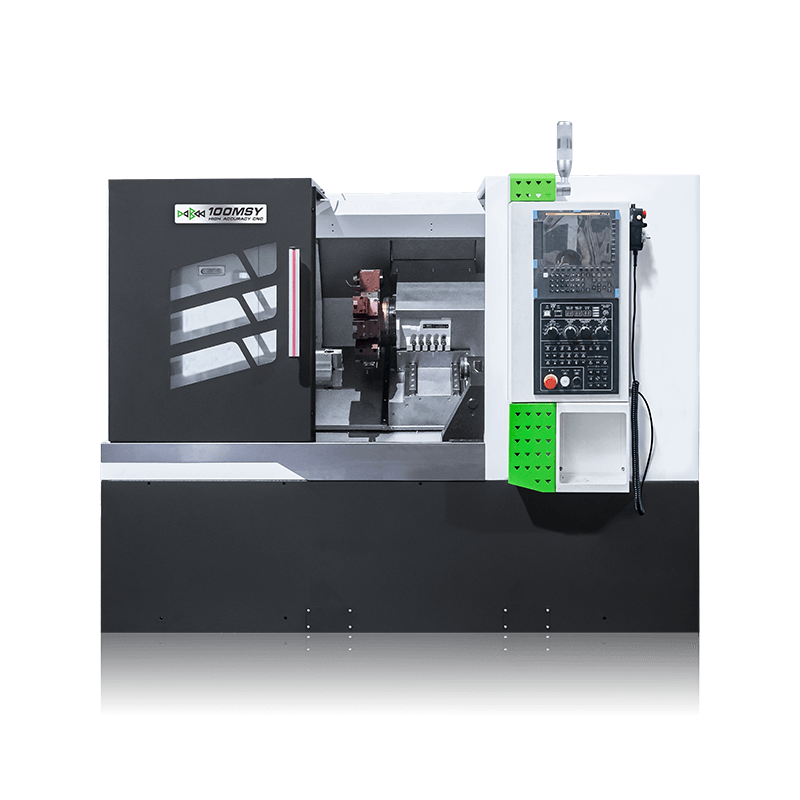
A Y-axis twin-spindle CNC lathe is a composite machining equipment developed from traditional CNC lathes. It integrates Y-axis motion capability and a twin-spindle structure, allowing multiple machining operations to be completed on a single machine tool. Compared to ordinary CNC lathes, this equipment not only has X-axis and Z-axis motion but also adds a Y-axis, enabling the tool to perform eccentric milling, side milling, and complex contour machining, thereby expanding the machining range.
The twin-spindle structure typically consists of a main spindle and a sub-spindle. The main spindle is responsible for the initial clamping of the workpiece and the main machining operations. After machining one end, the sub-spindle can automatically pick up the workpiece, achieving flipping or secondary clamping without manual intervention. This method reduces errors caused by repeated clamping and helps improve machining accuracy and consistency.
During operation, the CNC system controls the linkage of each axis according to a pre-programmed sequence. The addition of the Y-axis allows the turret or power tool to move perpendicular to the X and Z axes, enabling milling, drilling, and tapping operations in conjunction with the power tool. Through the coordinated operation of the dual spindles and the Y-axis, CNC lathes can achieve combined turning and milling machining, shortening the machining cycle, improving production efficiency, and are widely used in the manufacture of precision parts and complex structures.
The Y-axis is not simply about adding a direction of motion; its core value lies in expanding machining freedom. Without a Y-axis, twin-spindle lathes primarily rely on the X/Z axes for machining rotating bodies. However, when dealing with eccentric, asymmetrical, or planar structures, secondary clamping or transfer to a machining center is often required.
The addition of the Y-axis gives twin-spindle lathes the following advantages:
The core capability of a Y-axis dual-spindle CNC lathe stems from the collaborative operation of multiple systems. The "dual spindles + Y-axis + powered turret" constitute a highly integrated machining unit.
In actual machining, the three components are coordinated through the CNC system. For example, after completing external diameter machining on the main spindle, the powered turret can cooperate with the Y-axis for side milling; subsequently, the workpiece is transferred to the secondary spindle, where the end face and hole machining are completed on the other side. The entire process requires no manual intervention, forming a continuous machining chain. This collaborative logic transforms the lathe from a "single turning device" into a "composite machining platform."
From an application perspective, the main differences between Y-axis twin-spindle lathes and conventional twin-spindle lathes lie in their machining capabilities and applicable range.
The main advantage of conventional twin-spindle lathes is continuous machining on both sides, suitable for parts with relatively simple structures and primarily rotating bodies. Y-axis twin-spindle lathes, on the other hand, further enhance their adaptability to complex structures.
Specific differences include:
Therefore, in the context of increasingly complex machining tasks, the value of the Y-axis structure becomes more apparent.
Y-axis twin-spindle lathes are composite CNC machine tools integrating turning, milling, and other machining methods, widely used in complex parts and high-efficiency mass production. Through the coordinated movement of the main spindle, sub-spindle, and Y-axis, they enable multiple processes to be completed in a single setup, thereby improving machining accuracy and production cycle time. Understanding their key parameters is helpful for equipment selection and process optimization.
Structurally, Y-axis twin-spindle lathes are typically equipped with a powered turret and a multi-axis linkage control system, placing high demands on machine tool rigidity, precision, and stability. Key parameters directly affect machining capacity, applicable workpiece range, and production efficiency.
Key parameters include:
Application of Y-axis twin-spindle lathes in automotive parts machining: Many automotive parts possess typical rotational characteristics and also include side holes, mounting planes, or functional slots. Examples include steering system connectors, drive shaft end structures, and braking system metal components, which often require a combination of turning and side machining. Y-axis twin-spindle lathes, by introducing Y-axis feed capability into a twin-spindle structure, enable tools to perform milling, drilling, or grooving operations in off-center positions, thereby reducing workpiece transfer between different machines.
In actual production, the main spindle and the auxiliary spindle can each handle front and back surface machining tasks, with workpieces automatically transferred within the machine. Working in conjunction with the Y-axis and powered tools, multi-face machining is completed, helping to shorten the overall machining cycle time. For mass-produced automotive parts, this machining method not only improves equipment utilization but also helps maintain dimensional and positional consistency.
These parts typically contain rotational features as well as side holes, planes, or mounting slots. Y-axis twin-spindle lathes can complete more machining operations in a single setup, helping to improve production speed and stabilize quality levels.
Furthermore, as automotive parts become increasingly lightweight and integrated, the adaptability of Y-axis twin-spindle lathes in machining complex parts becomes increasingly apparent, providing greater process integration space for the production line.
In actual production, the selection of a suitable Y-axis twin-spindle CNC lathe should be based on the part's technological requirements and production mode, rather than simply focusing on the number of configurations.
First, the structural characteristics of the part need to be analyzed. If the workpiece, in addition to rotating surfaces, also contains side holes, planes, keyways, or eccentric structures, the Y-axis function can significantly improve machining flexibility. If the part is mainly composed of simple shafts, the necessity of a Y-axis configuration can be assessed based on actual needs.
Second, the machining process integration capability should be considered. Y-axis twin-spindle CNC lathes, through the coordinated operation of the twin spindles, Y-axis, and powered tools, can complete multiple processes in a single setup, helping to reduce process dispersion and repetitive positioning, making them suitable for production scenarios requiring consistent machining.
Third, production cycle time and batch characteristics must be considered. For medium to large batch production, equipment stability, spindle synchronization capability, and tool change efficiency are particularly important; while in multi-variety machining environments, the Y-axis travel range and programming flexibility are more noteworthy.
Appropriate selection helps achieve a balance between efficiency, cost, and long-term use.
Dongfang CNC is an equipment manufacturing company specializing in the R&D and production of CNC lathes. The company offers a variety of CNC lathe product series and provides customized solutions, covering multiple machine types including horizontal lathes, vertical lathes, and automated production lines.
For machining tasks requiring integrated multi-axis machining and a high degree of automation, choosing a CNC lathe with Y-axis feed and powered tooling capabilities helps improve production efficiency in terms of process integration, repeatability, and machining consistency. Communicating with equipment suppliers regarding the specific Y-axis travel, main and auxiliary spindle collaborative control capabilities, and after-sales service system of each machine model, based on actual process requirements, can help the purchaser make a more suitable selection.
RECOMMENDED PRODUCTS
All of your quotes will be answered within 2 hours by our professional sales support.
Use reliable parts and components to ensure product quality.
You can expect your order fulfilled within 60 days after placing the order.
All our products come with a one-year warranty.



sales@east-cnc.com

Shangma Industry Area, Shitang Town, Wenling City, Taizhou, Zhejiang, China.

Copyright © Taizhou Eastern CNC Technology Co., Ltd.

Machine Tool Manufacturer Privacy Policy