


 English
 русский
 Español
 عربى
عربى 简体中文
简体中文
Contact Us
All of your quotes will be answered within 2 hours by our professional sales support.
Industry News
 2026.07.17
 Industry News
Contents
In the metal-cutting industry, the "machine bed" is a component often overlooked by buyers, yet it is the decisive factor in whether a lathe can operate with long-term stability. While the visual differences between the two common bed structures—CNC flat bed and CNC slant bed—are immediately apparent, they differ significantly in practical application regarding workpiece clamping, chip evacuation, and the retention of machining accuracy. For traders, OEMs, and equipment distributors who regularly source machine tools, understanding the distinctions between these two designs can help avoid costly missteps.
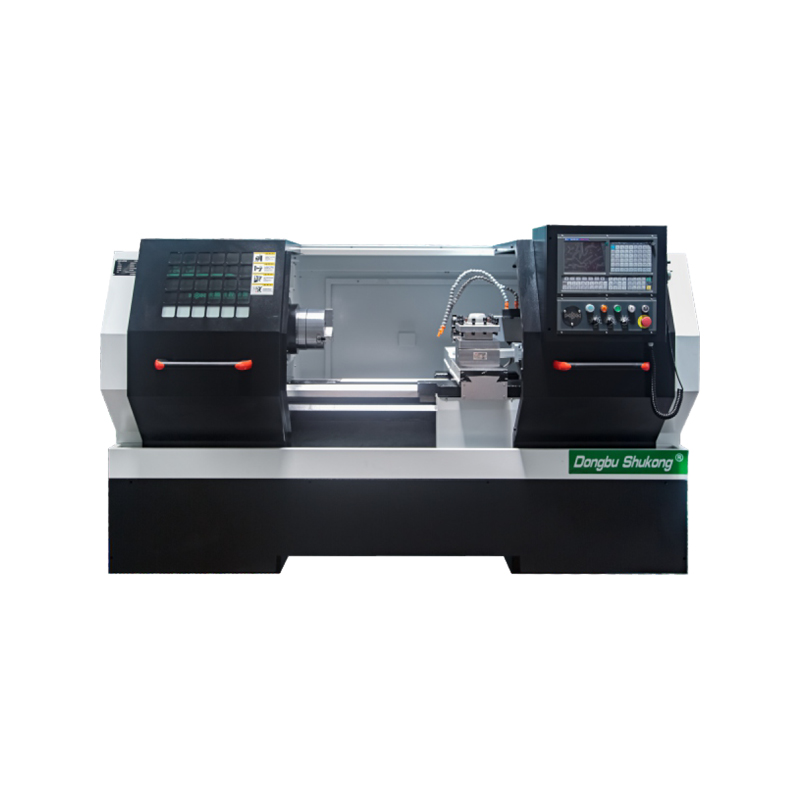
A CNC Flat Bed—also known as a horizontal-bed CNC lathe—is a type of lathe characterized by bed guideways that lie in a horizontal plane parallel to the ground. Once the workpiece is clamped in the chuck, it rotates horizontally, while the cutting tool moves along the X and Z axes to perform operations such as turning, facing, and threading. This configuration evolved from the traditional horizontal lathe; however, by replacing manual operation with a CNC control system, both machining repeatability and the level of automation have been significantly enhanced.
Flat-bed designs are common in workshops, particularly for machining long shafts, sleeves, and disc-shaped parts. This is because the horizontal bed provides a large support surface for the workpiece, minimizing the risk of sagging or deformation when clamping long components.
The characteristics of the CNC Flat Beds are primarily reflected in the following aspects:
Stable Structure — The integrally cast bed, combined with guideway protection, ensures relatively low vibration during cutting, making it particularly suitable for the continuous machining of medium-to-long workpieces.
Convenient Workholding — The horizontal bed and open layout make loading and unloading intuitive, allowing many clamping operations to be performed without additional auxiliary equipment.
Broad Machining Range — These lathes can handle a wide variety of parts, ranging from slender shafts to medium-diameter disc components, making them suitable for many factories to utilize as general-purpose workshop equipment.
Ease of Maintenance — Due to their relatively simple structure, inspecting and replacing core components—such as guideways and ball screws—is straightforward and does not require complex disassembly or reassembly procedures.
Flexible Control System Compatibility — Flat-bed lathes are compatible with mainstream CNC systems such as GSK, FANUC, and Siemens, allowing buyers to make flexible choices based on operational preferences and budget constraints.
From the perspectives of procurement and operation, CNC Flat Beds offer several practical benefits:
It should be noted, however, that these advantages do not mean flat-bed lathes are good to slant-bed lathes in every scenario; the choice depends on the specific workpiece being machined. Let us now compare the differences between the two.
The fundamental difference lies in the angle of the bed guideways relative to the ground: flat-bed guideways are horizontal, whereas slant-bed guideways are typically inclined at an angle of 30° to 60°. This difference in angle influences several aspects, including machine layout, machining accuracy, and overall machine rigidity.
| Comparison Criteria | Flat-Bed CNC Lathe | Slant-Bed CNC Lathe |
| Machine Layout | Horizontal guideways; open workspace; intuitive workpiece clamping | Inclined guideways; chips slide off naturally due to gravity |
| Chip Removal | Requires an auxiliary chip removal device | Relies on the inclined structure for natural chip removal; easier maintenance |
| Accuracy Retention | Localized guideway wear after prolonged cutting may affect the accuracy consistency | Cutting force direction aligns better with gravity; generally offers long-term accuracy stability |
| Overall Rigidity | Relies on bed casting thickness and guideway protection design | Inclined structure increases the load-bearing cross-section; offers more balanced overall rigidity |
| Automation Compatibility | Requires modification to integrate robotic loading/unloading | Structure is inherently easier to integrate into automated production lines |
| Suitable Workpieces | Long shafts and slender rod-like parts | Small-to-medium discs, sleeves, and parts requiring multi-process continuous machining |
From a purchasing perspective, a flat-bed CNC lathe is a pragmatic choice if the workpieces are primarily long shafts, workshop space is limited, and the budget is relatively tight. Conversely, a slant-bed CNC lathe is better suited to requirements involving automated continuous production lines, small-to-medium disc or sleeve parts, and a need for high chip removal efficiency. When selecting a machine, many B2B buyers also consider factors such as the automation level of existing production lines, operator habits, and ease of future maintenance, rather than simply focusing on which structure is more "advanced."
Eastern CNC offers a range of CNC Flat Bed models designed to meet diverse machining needs, spanning from small/medium-duty to heavy-duty applications. These machines typically feature a one-piece cast bed and fully enclosed guideway protection, which minimizes the impact of chips and coolant on guideway precision. The X and Z axes are driven by servo motors via precision ball screws with fixed mounts at both ends; this design enhances structural rigidity and reduces deformation during high-speed positioning. The spindle assembly utilizes angular contact bearings and variable-frequency speed control, balancing a wide speed range with low operating noise. Most models are equipped with a centralized automatic lubrication system, reducing the need for manual inspections.
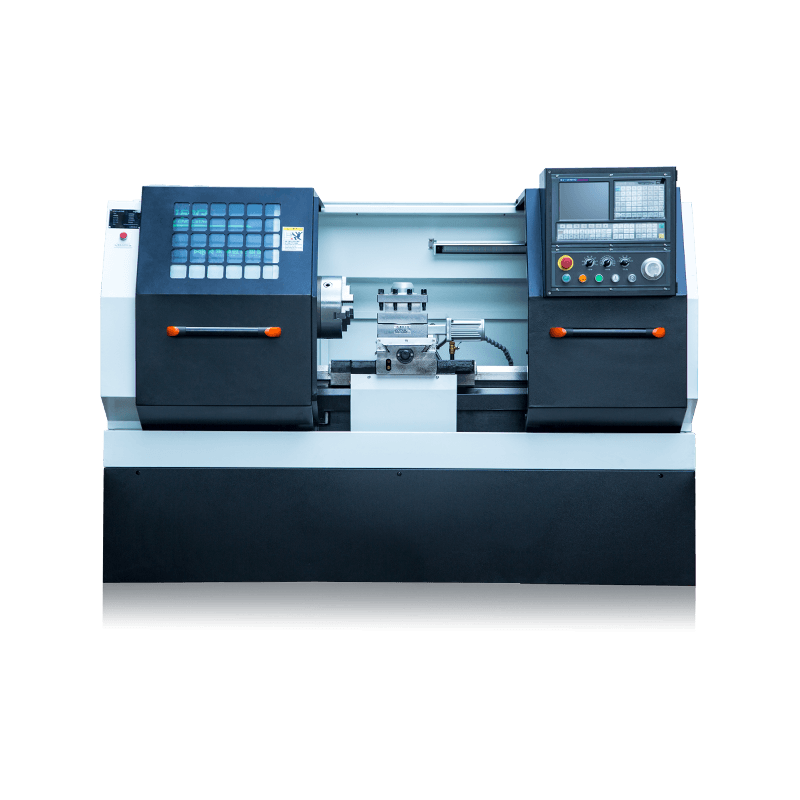
The CK6150 is a particularly notable model in this lineup, designed primarily for the batch processing of shaft, sleeve, and disc-type components. The table below summarizes the typical industry specifications for this model; actual specifications depend on the specific configuration selected and the manufacturer's confirmed technical data:
| Parameter | Reference Value |
| Max. Swing Over Bed | Approx. 500mm |
| Max. Swing Over Carriage | Approx. 270–300mm |
| Max. Machining Length | 750/1000/1500mm (options available) |
| Spindle Bore | Approx. 82mm |
| Spindle Speed Range | 30–1600 rpm (3-speed gear range) |
| Repeatability | Approx. 0.007mm |
| Main Motor Power | Approx. 7.5kW |
| Optional CNC Systems | GSK, FANUC, Siemens, etc. |
The CK6150 supports manual clamping with a 3-jaw chuck but can also be configured with optional accessories such as hydraulic chucks and automatic bar feeders based on order requirements. Turret options typically include 4-station or 6-station configurations to accommodate different batch production workflows. For buyers involved in export or OEM/ODM manufacturing, a key advantage of this model is its configuration flexibility; it allows for customization based on specific downstream process requirements, rather than limiting the buyer to fixed, standard packages.
Q1: Are CNC Flat Beds and ordinary lathes the same thing?
Not exactly the same. Ordinary lathes rely on manual feeding and operation, while CNC Flat Beds control the X and Z-axis servo motors through the CNC system to automatically complete the processing path. The processing repeatability and degree of automation are much higher.
Q2: What materials are suitable for CNC Flat Bed lathe to process?
Common carbon steel, alloy steel, stainless steel, aluminum alloy and other metal materials can be processed. The specific cutting parameters need to be adjusted according to the material hardness and tool selection.
Q3: When choosing a flat bed lathe, what reference should be made to the spindle bore diameter?
The spindle hole diameter mainly depends on the diameter of the bar or pipe to be processed. A small hole diameter will limit the specifications of the workpieces that can be processed. Before purchasing, it is recommended to clarify the size range of conventional workpieces and then compare the selection.
Q4: Can a flat bed lathe be equipped with an automatic loading and unloading device later?
Yes, but it needs to be evaluated based on the specific bed structure and operating space. Some CNC Flat Beds have reserved automated docking interfaces in the design stage. You can communicate this requirement with the manufacturer in advance when purchasing.
Q5: Do flat bed lathes such as CK6150 support OEM/ODM customization?
support. Configuration items such as the number of turret stations, chuck type, and CNC system brand can usually be adjusted according to order requirements. It is recommended to confirm the specific customization scope directly with the manufacturer's technical team.
RECOMMENDED PRODUCTS
All of your quotes will be answered within 2 hours by our professional sales support.
Use reliable parts and components to ensure product quality.
You can expect your order fulfilled within 60 days after placing the order.
All our products come with a one-year warranty.



sales@east-cnc.com

Shangma Industry Area, Shitang Town, Wenling City, Taizhou, Zhejiang, China.

Copyright © Taizhou Eastern CNC Technology Co., Ltd.

Machine Tool Manufacturer Privacy Policy